LAST MEDICALLY REVIEWED:
September 2026 — Dr. Shaileshkumar Garge
Citi Vascular Hospital, KPHB Colony, Road No. 1, Hyderabad, Telangana 500072
No-scalpel vasectomy in Hyderabad is a safe, 15–30 minute permanent birth control procedure available from ₹15,000–₹40,000 at Citi Vascular Hospital, KPHB — with over 99% effectiveness after semen confirmation, 2–7 day recovery, same-day discharge, and no effect on testosterone, erections, or sexual performance.Performed by Dr. Vamshi Mohan and Dr Garge — this complete guide covers the no-scalpel procedure step by step, preparation checklist, day-of-procedure patient journey, week-by-week recovery timeline, post-vasectomy semen testing protocol, risks, reversal success rates, cost breakdown, and insurance guidance — helping men and couples across Kukatpally, Miyapur, Hitech City, Ameerpet, Secunderabad, and Hyderabad make a fully informed decision.
|
Feature |
Quick Answer |
|
Procedure Name |
No-Scalpel Vasectomy (NSV) — preferred technique at Citi Vascular, KPHB |
|
Procedure Duration |
15–30 minutes |
|
Anaesthesia |
Local anaesthesia — you remain awake and comfortable throughout |
|
Hospital Stay |
Day-care procedure — discharged same day |
|
Recovery Time |
2–7 days for routine activities; 1 week to avoid strenuous exercise |
|
Return to Office Work |
1–3 days for desk work; 5–7 days for physical jobs |
|
Sexual Function After Vasectomy |
Completely unaffected — testosterone, erections, libido, orgasm all normal |
|
Effectiveness |
Over 99% after semen analysis confirms azoospermia (zero sperm) |
|
Is Vasectomy Permanent? |
Yes — must always be considered a permanent, irreversible decision |
|
Reversible? |
Technically possible — success decreases with time; not guaranteed |
|
When Does Vasectomy Become Effective? |
Only after semen analysis at 8–12 weeks confirms zero sperm — NOT immediately |
|
Cost in Hyderabad (2026) |
₹15,000–₹40,000 all-inclusive at Citi Vascular Hospital, KPHB |
|
Insurance Coverage |
Government family planning schemes often cover vasectomy; check individual policies |
|
Performed By |
Dr. Vamshi Mohan DNB Surgery and Dr Garge, |
|
Available At |
Citi Vascular Hospital, KPHB Colony, Road No. 1, Hyderabad — +91-73375 83901 |
Book Your Vasectomy Consultation in Hyderabad
No-Scalpel Vasectomy | 15–30 Min | Same-Day Discharge | Confidential | Dr. Vamshi, KPHB
+91-73375 83901 | WhatsApp | citivascularcentre.com
Transparent Pricing from ₹8,000 | EMI Available | Insurance Guidance | Complete Privacy
Book your Appointment here: | Appoinment: |Call +91-7032508468| Whatsapp:+91-7337583901
Am i the right candidate for vasectomy?
Vasectomy Near You in Hyderabad
Summary
|
Step |
Check This Question |
YES → Next |
NO → Action |
|
1 |
Are you completely certain you do not want biological children in the future? |
→ Step 2 |
Do not proceed — vasectomy is permanent |
|
2 |
Have you discussed this decision with your partner and reached a joint decision? |
→ Step 3 |
Discuss with partner before deciding |
|
3 |
Have you considered this seriously for at least 6 months without doubt or uncertainty? |
→ Step 4 |
Take more time — this is irreversible |
|
4 |
Are you in good general health with no active genital infection or bleeding disorder? |
→ Step 5 |
Address medical issue first, then reassess |
|
5 |
Do you understand vasectomy is NOT immediately effective and requires semen testing? |
→ Step 6 |
Learn post-vasectomy protocol first |
|
6 |
Do you want a simpler, less invasive, and more affordable option than female sterilization? |
✅ Book a vasectomy consultation at Citi Vascular, KPHB |
Discuss female sterilization as an alternative |
⚠️ Every man considering vasectomy must have a full pre-procedure consultation with Dr. Vamshi Mohan and Dr Garge at Citi Vascular Hospital, KPHB. Younger men, men in new relationships, and those with any doubt are extensively counselled before scheduling. Call +91-73375 83901.
|
When |
Preparation Step |
Details / Notes |
|
1–2 Weeks Before |
Initial consultation with Dr. Garge |
Confirm suitability, review medical history, discuss future fertility plans |
|
1 Week Before |
Review current medications |
Blood-thinning medications (aspirin, warfarin, clopidogrel) paused if medically appropriate — confirm with your doctor |
|
Day Before |
Prepare the area if advised |
Shower and follow any specific scrotal preparation instructions provided by the clinic |
|
Day of Procedure |
Wear comfortable, supportive clothing |
Wear tight/supportive underwear or a jockstrap to reduce swelling and discomfort post-procedure |
|
Day of Procedure |
Arrange transportation home |
You CANNOT drive yourself home — arrange a friend, family member, or auto/taxi for the return journey |
|
Day of Procedure |
No fasting required in most cases |
Light meal is acceptable — no general anaesthesia, so extended fasting is not routinely necessary |
|
Day of Procedure |
Bring your identification and documents |
ID, insurance card (if applicable), referral letter, and any relevant scan/test reports |
|
Emotional |
Final decision confirmation |
A brief counselling check is completed on the day — confirm you are still certain about proceeding |
|
1 |
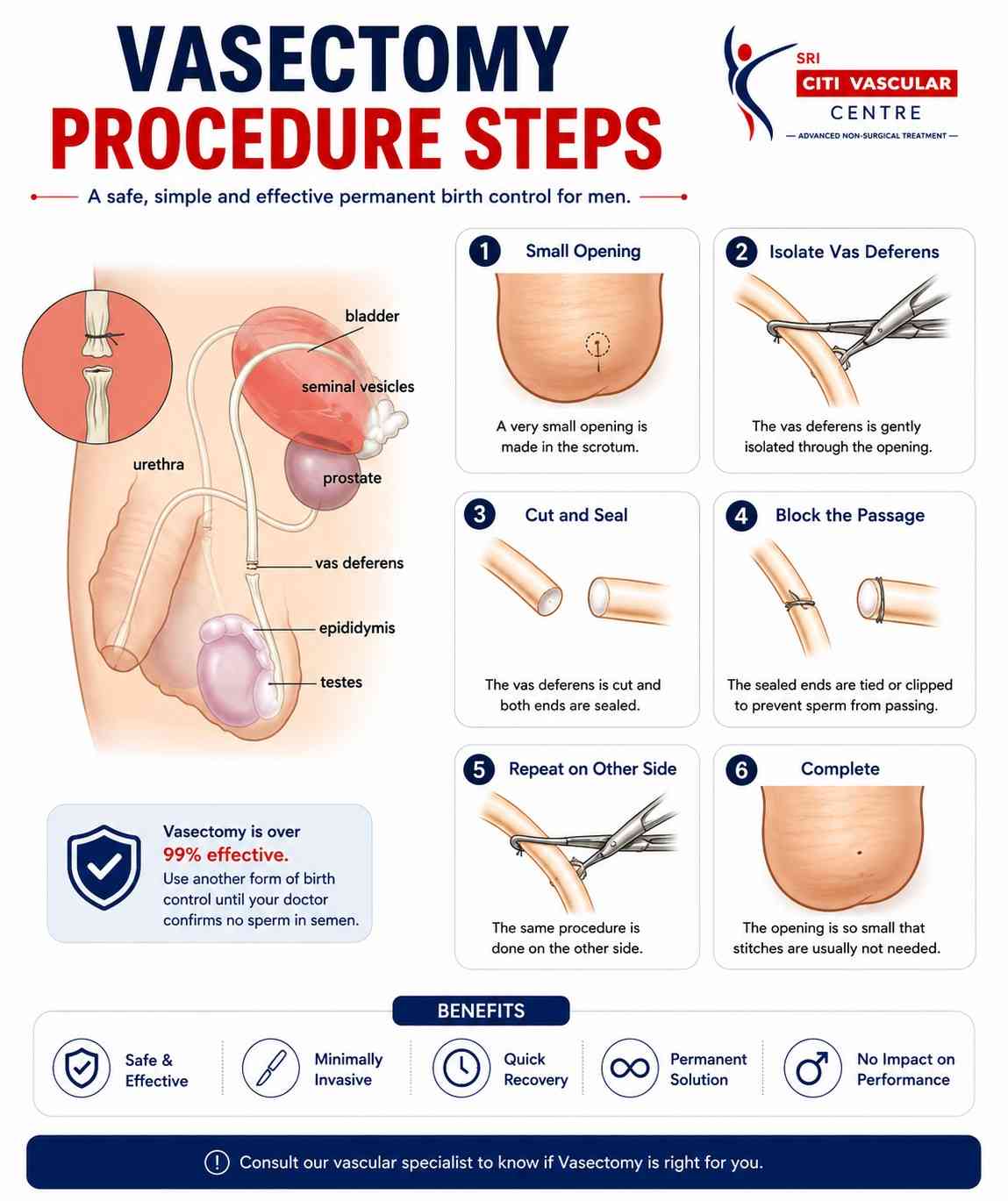
Consultation & Counselling (30–45 Minutes) Dr. Vamshi Mohan or Dr Garge reviews your medical history, current medications, general health, and fertility plans in detail. The procedure, both technique options (no-scalpel vs conventional), realistic expectations, risks, recovery, and the requirement for post-vasectomy semen testing are explained fully. Informed written consent is obtained. A pre-procedure clinical examination confirms suitability and the most appropriate technique. |
|
2 |
Local Anaesthesia Injection A small amount of local anaesthetic is injected into the scrotal skin using a fine needle. You feel a brief stinging sensation for 5–10 seconds — after which the area is completely numb. No general anaesthesia is required. You remain awake, relaxed, and comfortable throughout. Most men say this is the most uncomfortable moment of the entire procedure. |
|
3 |
Locating the Vas Deferens Dr. Vamshi Mohan gently palpates the scrotum to precisely locate the vas deferens — the firm, cord-like tube beneath the skin that carries sperm from the testicle. The vas is held firmly but gently in place using a ring clamp. You feel pressure but no pain at this stage. Both sides are accessed through the same or separate entry points. |
|
4 |
No-Scalpel Access — Tiny Puncture (No Incision, No Stitches) Using a specially designed pointed dissecting clamp — not a scalpel — Dr. Vamshi Mohan creates a tiny puncture in the scrotal skin, approximately 2–3mm wide. The vas deferens is gently brought to the surface through this opening. No surgical incision is made, no stitches are needed, and there is no bleeding from a cut. This is the key advantage of no-scalpel vasectomy over conventional technique. |
|
5 |
Blocking the Vas Deferens (Both Sides) A small section of the vas deferens is divided and blocked using one or more techniques: cutting and removing a segment, cauterising (heat sealing) the ends, tying with sutures, or applying titanium clips — technique selection is based on anatomy. This is repeated on the opposite vas deferens through the same or an adjacent puncture. The procedure is complete when both vas deferens are permanently blocked. |
|
6 |
Closure — No Stitches Required The tiny 2–3mm puncture in the scrotal skin is so small it requires no sutures in most no-scalpel cases. The skin naturally closes on its own. A small sterile dressing or adhesive strip is applied. The entire procedure from anaesthetic injection to closure typically takes 15–25 minutes for a no-scalpel vasectomy performed by an experienced specialist. |
|
7 |
Recovery Observation & Discharge Instructions You rest comfortably in the recovery area for 20–30 minutes while vital signs are monitored. Post-procedure instructions are provided: wear supportive underwear for 48 hours, apply ice packs on/off for the first 24 hours, take prescribed pain medication as needed, rest at home for 24–48 hours, avoid heavy lifting for 1 week, and resume sexual activity after 7 days — with contraception until semen analysis confirms clearance. |
|
Stage |
Phase |
What Happens |
Timeframe |
|
1 |
Consultation |
Medical history review, counselling, suitability confirmation, informed consent |
1–2 weeks before |
|
2 |
Preparation |
Final pre-procedure checks, local anaesthesia applied, IV access if needed |
Day of procedure — 30 min before |
|
3 |
No-Scalpel Procedure |
Tiny puncture, vas deferens accessed, both sides divided and permanently blocked |
15–30 minutes |
|
4 |
Recovery |
Monitored in recovery bay, discharge instructions given, ride home arranged |
20–30 min post-procedure |
|
5 |
Home Recovery |
Rest, ice packs, supportive underwear, avoid strenuous activity, manage with pain meds |
Days 1–7 |
|
6 |
Sperm Clearance |
Regular ejaculation helps clear residual sperm above the blockage — continue contraception |
Weeks 1–12 |
|
7 |
Semen Analysis |
Lab semen test confirms azoospermia (zero sperm) — critical step before stopping contraception |
8–12 weeks post-procedure |
|
8 |
Confirmed Effective |
Zero sperm confirmed = vasectomy fully effective. Contraception can now be stopped safely. |
After clearance confirmed |
|
Time |
Stage |
What Happens / Patient Experience |
|
Arrival (2 hrs before) |
Registration & documentation |
ID check, consent review, insurance documentation if applicable. Scrotal preparation reviewed. |
|
30–60 min before |
Pre-procedure assessment |
Vital signs, blood pressure, general wellbeing check. Final counselling question: 'Are you still certain?' answered. |
|
15 min before |
Preparation & positioning |
Comfortable positioning on procedure table. Supportive underwear provided. Surgical area cleaned and prepared. |
|
Procedure (15–30 min) |
No-Scalpel Vasectomy |
Local anaesthetic injection — brief sting. Area fully numb within 60–90 seconds. Procedure performed. You feel only pressure — no pain. Music/conversation available. |
|
Immediately after |
Dressing applied |
Tiny puncture covered with sterile dressing or adhesive strip. Supportive underwear worn immediately. |
|
20–30 min post-procedure |
Recovery bay |
Vital signs monitored. Mild soreness expected and managed with oral pain relief. Clear discharge instructions given. |
|
Same day — discharge |
Home with support |
Discharged with oral medications, post-procedure care sheet, and follow-up appointment for semen analysis at 8–12 weeks. Cannot drive self home. |
|
Time After Vasectomy |
What to Expect |
Dos & Don'ts |
|
Day 0 — Procedure Day |
Mild soreness begins as local anaesthetic wears off (1–2 hours). Minor swelling and bruising normal. |
✅ Rest at home. ✅ Ice pack 20 min on/off. ❌ No driving. ❌ No lifting. |
|
Days 1–2 |
Peak soreness — scrotal tenderness and bruising may increase slightly before improving. Fatigue normal. |
✅ Supportive underwear. ✅ Paracetamol/ibuprofen. ✅ Rest. ❌ No sex. ❌ No exercise. |
|
Days 3–5 |
Most men feel significantly better. Light daily activities resume. Bruising begins to fade. |
✅ Short walks. ✅ Return to desk work. ❌ No gym. ❌ No cycling. ❌ No heavy lifting. |
|
Day 7 |
Most men feel normal. Sexual activity can resume — WITH contraception until semen test confirms clearance. |
✅ Resume normal activities. ✅ Sex with contraception. ❌ No unprotected sex yet. |
|
Week 2 |
Full return to exercise and physical work. Any remaining bruising continues to fade. |
✅ Full exercise. ✅ Cycling OK. ✅ Continue contraception strictly. ❌ No unprotected sex. |
|
Weeks 8–12 |
Semen analysis appointment — critical step. Lab confirms presence or absence of sperm in ejaculate. |
✅ Book semen test. ✅ Continue contraception until confirmed clear. ❌ Do NOT skip this step. |
|
After Clearance |
Zero sperm confirmed on semen analysis — vasectomy is now fully effective. Stop contraception safely. |
✅ Vasectomy fully effective. ✅ No further action needed in most cases. |
|
⚠️ Warning — Seek Review |
Fever > 38°C, worsening swelling, discharge, or large lump not resolved by Day 7 require medical review. |
⚠️ Call Citi Vascular Hospital immediately: +91-73375 83901 |
Book your Appointment here: | Appoinment: |Call +91-7032508468| Whatsapp:+91-7337583901
|
Phase / Time |
What Is Happening |
Patient Action Required |
|
Immediately Post-Procedure |
Residual sperm remain in vas deferens above the blockage — vasectomy NOT yet effective |
✅ Continue ALL contraception without exception. Do NOT stop. |
|
Weeks 1–7 |
Sperm gradually clear through regular ejaculation. Body reabsorbs remaining sperm naturally. |
✅ Continue contraception. ✅ Ejaculate regularly — this helps clear sperm faster. |
|
Week 8–12 (or ~20 ejaculations) |
Semen analysis specimen produced at home, delivered to laboratory within 1 hour, analysed microscopically. |
✅ Book semen analysis. ✅ Continue contraception until result received. |
|
Result: AZOOSPERMIA (No sperm) |
Vasectomy confirmed successful — sperm pathway permanently blocked and clear |
✅ Vasectomy is NOW fully effective. Contraception can be stopped safely. |
|
Result: Rare non-motile sperm only |
Some specialists accept this as sufficient clearance — discuss individually with Dr. Garge or Dr Vamshi Mohan |
✅ Follow-up semen test recommended at 3 months to reconfirm |
|
Result: Live/motile sperm still present |
Vasectomy may not be fully effective — re-evaluation urgently required |
⚠️ Do NOT stop contraception. Contact Citi Vascular Hospital immediately. |
⚠️ Critical Reminder: NEVER stop contraception based on time alone. Only a laboratory semen test confirming zero sperm (azoospermia) means vasectomy is effective. Skipping the semen analysis is the most common reason for post-vasectomy pregnancy.
|
Risk / Complication |
Description |
Frequency |
Management |
|
Scrotal soreness / bruising |
Mild to moderate tenderness, visible bruising around scrotum |
Almost all patients |
Ice packs, paracetamol/ibuprofen, supportive underwear — resolves in 3–5 days |
|
Infection |
Redness, increasing warmth, fever, discharge from puncture site |
~2% of cases |
Oral antibiotics — contact Dr. Garge at Citi Vascular if fever > 38°C develops |
|
Haematoma |
Blood collects in scrotal tissue causing swelling and bruising |
Uncommon — ~1–3% |
Rest and ice — most resolve spontaneously; rarely requires drainage |
|
Sperm Granuloma |
Small firm lump forms at the vasectomy site due to sperm leakage |
< 5% of cases |
Usually painless and resolves without treatment; anti-inflammatory if symptomatic |
|
Chronic Pain (PVPS) |
Persistent scrotal discomfort lasting more than 3 months after vasectomy |
~1–2% significant; up to 7% mild |
NSAIDs, nerve block, or referral — most mild cases improve over time |
|
Recanalization |
Vas deferens reconnects naturally — extremely rare after confirmed effective vasectomy |
Very rare — < 1 in 2,000 |
Repeat vasectomy or alternative contraception — detected on semen analysis |
|
Failed Vasectomy |
Persistent sperm on post-vasectomy semen analysis — procedure did not achieve azoospermia |
< 1% |
Repeat vasectomy planned after full assessment by Dr. Garge |
Warning Signs — Contact Citi Vascular Hospital Immediately (+91-73375 83901): Fever above 38°C | Increasing (not decreasing) pain after Day 3 | Significant worsening swelling | Discharge from puncture site | A new firm lump that is enlarging | Feeling unwell systemically (nausea, chills). Most vasectomy recoveries are uneventful — these symptoms are uncommon but require prompt review.
|
Scenario |
Risk Level |
Clinical Explanation |
|
Semen analysis skipped — contraception stopped early |
⚠️ HIGH RISK |
Residual sperm still present — most preventable cause of post-vasectomy pregnancy |
|
Semen analysis completed — azoospermia confirmed |
✅ Very Low — < 0.1% |
Vasectomy confirmed effective. Only extremely rare late recanalization poses any residual risk. |
|
Recanalization (spontaneous reconnection) |
Very Rare — < 1 in 2,000 |
Vas deferens reconnects naturally years after vasectomy. Detected on repeat semen analysis. |
|
Early resumption of unprotected sex (before clearance) |
⚠️ MODERATE RISK |
Sperm remain above the blockage. Contraception must continue until semen analysis confirms clearance. |
|
Late failure after confirmed clearance |
Extremely Rare |
< 0.1% of confirmed vasectomies — exceptionally rare but not impossible. Annual semen check optional after 1 year. |
Key Message: Vasectomy failure after confirmed semen analysis clearance is extremely rare (< 0.1%). The most common cause of post-vasectomy pregnancy is stopping contraception before the semen analysis confirms zero sperm. Always complete the semen test at 8–12 weeks before abandoning contraception.
|
Feature |
Vasectomy (Male) |
Tubectomy / Female Sterilisation |
|
Procedure Invasiveness |
Minimally invasive — tiny 2–3mm puncture |
Laparoscopic / abdominal surgery |
|
Anaesthesia |
Local anaesthesia only |
General or spinal anaesthesia |
|
Procedure Duration |
15–30 minutes |
30–60 minutes |
|
Hospital Stay |
Day procedure — home same day |
Usually 1 day or overnight |
|
Recovery Time |
2–7 days |
1–2 weeks |
|
Risk of Complications |
Low — minor bruising, soreness |
Slightly higher — internal laparoscopic procedure |
|
Effectiveness |
Over 99% after semen confirmation |
Over 99% |
|
Cost in Hyderabad 2026 |
₹8,000–₹20,000 at Citi Vascular, KPHB |
₹25,000–₹60,000 approximately |
|
Reversal Possibility |
Vasectomy reversal — variable success (decreases with time) |
Tubal reversal — lower success rate than vasectomy reversal |
|
Effect on Hormones |
❌ None — testosterone completely unaffected |
❌ None — oestrogen completely unaffected |
|
Effect on Sexual Function |
❌ None — erections, libido, orgasm all normal |
❌ None — sexual function unaffected |
|
Recommended When |
Man is certain; simpler, faster, cost-effective option preferred |
Female sterilisation preferred; male vasectomy not feasible |
For most couples who have completed their family, vasectomy is the simpler, safer, faster, and significantly more affordable option. Both are equally effective. The decision must be made jointly and discussed with Dr. Vamshi Mohan or Dr Garge at Citi Vascular Hospital, KPHB before proceeding.
|
Not sure if vasectomy is right for you? Dr. Garge provides expert counselling in a completely confidential setting. +91-73375 83901 |
Check Your Insurance Coverage Many policies cover vasectomy. We handle all documentation. WhatsApp for Quick Reply |
|
❌ Common Myth |
✅ Clinical Fact |
???? Source |
|
Vasectomy causes impotence |
No effect on erections whatsoever — nerves and blood supply unaffected |
AUA Guidelines; Multiple controlled trials |
|
Vasectomy lowers testosterone |
Testosterone produced by testes — completely unaffected by vas deferens blockage |
Endocrine Society; AUA Patient FAQ |
|
Vasectomy affects erections |
Erectile function completely normal after vasectomy — confirmed in controlled studies |
Journal of Urology; AUA data |
|
Vasectomy affects masculinity |
Identity, masculinity, confidence, physical appearance — all completely unaffected |
Psychological outcome studies; AUA |
|
Ejaculation significantly changes |
Sperm = < 3% of semen volume. Volume, force, sensation identical before and after |
Semen composition studies; AUA |
|
Vasectomy is immediately effective |
NOT effective until semen analysis at 8–12 weeks confirms zero sperm |
SIR / AUA Post-Vasectomy Protocol |
|
Vasectomy reversal is always successful |
Success drops from ~97% (< 3 yrs) to < 30% (> 15 yrs) — never guaranteed |
Belker et al. Vasovasostomy Study |
|
Vasectomy causes prostate cancer |
No causal link confirmed in large-scale studies by ACS, WHO, or major urology bodies |
American Cancer Society; WHO 2023 |
|
Vasectomy is very painful |
Brief sting during anaesthetic injection only. Procedure painless; mild soreness 2–3 days |
NSV outcome data; Patient surveys |
|
Vasectomy = castration |
Completely different — testicles fully intact, producing testosterone and sperm normally |
Standard anatomy; AUA Guidelines |
|
Cost Component |
Approximate Cost (Hyderabad 2026) |
|
Initial Consultation |
₹500 – ₹1,500 |
|
Pre-Procedure Blood Tests (if required) |
₹800 – ₹2,000 |
|
No-Scalpel Vasectomy Procedure |
₹20,000 – ₹32,000 |
|
Conventional Vasectomy Procedure |
₹10,000 – ₹15,000 |
|
Post-Procedure Medications (1 week) |
₹500 – ₹1,500 |
|
Post-Vasectomy Semen Analysis (Week 8–12) |
₹500 – ₹1,500 at pathology lab |
|
Estimated Total — No-Scalpel Vasectomy |
₹15,000 – ₹40,000 (all-inclusive estimate at Citi Vascular Hospital, KPHB) |
|
Procedure |
Approx. Cost Hyderabad |
Key Notes |
|
No-Scalpel Vasectomy |
₹15,000–₹40,000 |
Local anaesthesia, day procedure, fastest recovery |
|
Conventional Vasectomy |
₹10,000–₹15,000 |
Same effectiveness, slightly longer recovery |
|
Female Sterilisation (Laparoscopic) |
₹25,000–₹60,000 |
General anaesthesia, 1-day stay, longer recovery |
|
Vasectomy Reversal |
₹50,000–₹1,50,000+ |
Microsurgery — NOT guaranteed to restore fertility |
All costs at Citi Vascular Hospital, KPHB are discussed transparently before the procedure. No hidden charges. EMI options available. Citi Vascular also assists with insurance pre-authorisation. Call +91-73375 83901 for a personalised cost estimate.
|
Insurance Type |
Vasectomy Coverage? |
Documents Typically Required |
|
Corporate / Group Mediclaim |
Sometimes — check policy |
Doctor recommendation, procedure note, hospitalisation letter |
|
Individual Health Insurance |
Varies — confirm with insurer |
Verify with insurer before appointment — male sterilisation coverage varies by policy |
|
Government Family Planning Schemes |
Often Yes — fully covered |
Referral from government hospital or PHC + proof of identity |
|
Ayushman Bharat / PMJAY |
Check empanelment status |
BIS card + referral letter + diagnosis confirmation |
|
Self-Pay / Out-of-Pocket |
N/A — pay directly |
Transparent pricing at Citi Vascular. EMI options available. Call to confirm rates. |
Rajesh's Experience
Rajesh, a 39-year-old software professional from Hyderabad, had completed his family and wanted a reliable permanent contraception option.
After consultation, he underwent a no-scalpel vasectomy that took approximately 20 minutes.
Returned home the same day
Resumed office work within 2 days
Experienced only mild soreness
Semen analysis confirmed success
“The procedure was much simpler than I expected, and recovery was quick.”
|
Outcome Measure |
Before Vasectomy |
After No-Scalpel Vasectomy |
|
Contraception method |
Ongoing — relying on female contraception |
Permanent — no ongoing contraception required |
|
Procedure anxiety |
Worried about pain and recovery |
'Much simpler than I expected' |
|
Procedure duration |
Expected 1–2 hours |
Completed in approximately 20 minutes |
|
Hospital stay |
Expected overnight admission |
Returned home same day — day procedure |
|
Work disruption |
Anticipated week off work |
Back to office within 2 days |
|
Pain experience |
Feared significant pain |
Only mild soreness — managed with oral medication |
|
Semen analysis result |
N/A — pre-procedure |
✅ Azoospermia confirmed — vasectomy fully effective |
Q1: How long does a no-scalpel vasectomy take?
No-scalpel vasectomy at Citi Vascular Hospital, KPHB, Hyderabad typically takes 15–25 minutes from local anaesthetic injection to dressing application. The complete clinic visit — including pre-procedure assessment and post-procedure observation — takes approximately 1.5–2 hours. This is performed as a day-care procedure with same-day discharge. No general anaesthesia or hospital admission is required.
Q2: Does vasectomy affect sexual performance, erections, or testosterone?
No. Vasectomy has absolutely no effect on sexual performance. Testosterone levels, erections, libido, ejaculation volume, orgasm sensation, and sexual satisfaction remain completely unchanged after the procedure. Only the sperm-carrying vas deferens is blocked — the testicles, nerves, blood supply, and hormonal system are entirely unaffected. Multiple controlled studies confirm vasectomy has no negative impact on sexual function.
Q3: Is vasectomy reversal possible after a no-scalpel vasectomy
Yes, vasectomy reversal (vasovasostomy) is technically possible after no-scalpel vasectomy. However, success rates decline significantly over time — from approximately 75–97% within 3 years to below 30% after 15+ years. Reversal is expensive (₹50,000–₹1,50,000+), requires general anaesthesia and microsurgery, and does not guarantee restored fertility. Every man must treat vasectomy as a permanent, irreversible decision.
Q4: What symptoms after vasectomy require urgent medical attention?
Seek urgent medical review if you experience: fever above 38°C | severe or worsening swelling beyond Day 3 | discharge or oozing from the puncture site | a firm, enlarging lump at the vasectomy site | or feeling systemically unwell (chills, nausea). Mild soreness and bruising are normal. Serious complications are uncommon but require prompt evaluation. Call Citi Vascular KPHB: +91-73375 83901.
Q5: What is the cost of no-scalpel vasectomy in Hyderabad 2026
No-scalpel vasectomy at Citi Vascular Hospital, KPHB, Hyderabad costs approximately ₹15,000–₹40,000 in 2026, including consultation, procedure, post-procedure medications, and follow-up semen analysis guidance. This is significantly less than female sterilisation (₹25,000–₹60,000). All costs are discussed transparently before the procedure — no hidden charges. EMI options available. Call +91-73375 83901 for a personalised estimate.
Q6: Is the no-scalpel technique better than conventional vasectomy?
Yes. No-scalpel vasectomy (NSV) is recommended by the World Health Organization as the preferred technique due to its lower complication rate. Compared to conventional vasectomy: no surgical incision, no stitches required, less bleeding, lower infection risk, lower haematoma risk, and faster recovery (2–5 days vs 3–7 days). Effectiveness after semen confirmation is identical — over 99% for both techniques.
Q7: How do I prepare for a vasectomy procedure?
Preparation for vasectomy is minimal. Key steps include: attend the initial consultation with Dr. Garge at Citi Vascular, KPHB; review and pause any blood-thinning medications as advised; shower on the morning of the procedure; wear supportive underwear on the day; arrange transportation home (you cannot drive yourself); and bring identification and any relevant medical documents. No fasting or general anaesthesia preparation is required.
Q8: Who performs vasectomy in Hyderabad?
At Citi Vascular Hospital, KPHB, vasectomy is performed by Dr. Vamshi Mohan, Dr Garge and Team. Both no-scalpel and conventional vasectomy techniques are available, with technique selection based on individual anatomy and clinical assessment.
|
Credential |
Detail |
|
Full Name |
Dr. Vamshi Mohan |
|
Qualifications |
MBBS | DNB Surgery |
|
Role |
Senior Consultant Surgeon |
|
Hospital |
Citi Vascular Hospital, KPHB Colony, Road No. 1, Hyderabad, Telangana 500072 |
|
Vasectomy Techniques |
No-Scalpel Vasectomy (NSV) + Conventional — technique selected per individual patient anatomy |
|
Total Procedures |
1200+ procedures performed across Hyderabad |
|
Specialisation |
Vasectomy, hydrocele, Circumcision, hernia, varicocele |
|
Technology |
Dedicated Cath Lab | Fluoroscopy | Colour Doppler | Advanced Imaging |
|
Serving |
KPHB, Kukatpally, Miyapur, Hitech City, Ameerpet, Secunderabad, Hyderabad & Telangana |
Citi Vascular Hospital, KPHB Colony, Road No. 1, Hyderabad is conveniently accessible for patients across:
Kukatpally & KPHB — 5 min drive via KPHB Main Road
Miyapur & Bachupally — 10 min via Miyapur X Roads
Pragati Nagar & Nizampet — 8–10 min
Hitech City & Madhapur — 20 min via IT Corridor
Ameerpet & SR Nagar — 20 min via Balanagar flyover
Gachibowli & Kondapur — 25 min via PVNR Expressway
Secunderabad & Begumpet — 25 min via NH 65
Kompally, Medchal & Alwal — 20–25 min via ORR
|
Hospital |
Contact |
Location & Hours |
|
Citi Vascular Hospital |
+91-73375 83901 |
KPHB Colony, Road No. 1, Hyderabad, Telangana 500072 | Mon–Sat 9AM–6PM |
|
Booking |
citivascularcentre.com |
Online + WhatsApp + Walk-in | Confidential consultations |
Confidentiality Assured: All vasectomy consultations and procedures at Citi Vascular Hospital, KPHB are conducted with complete privacy and discretion. No information is shared without your explicit consent.
Vasectomy Procedure Summary
✅ Safe and effective permanent birth control
✅ 15–30 minute procedure
✅ Performed under local anesthesia
✅ More than 99% effective after semen testing
✅ Minimal downtime
✅ Sexual performance unaffected
✅ Recovery usually within one week
Early consultation helps men understand whether vasectomy is the right long-term contraception option for their family planning goals.
Citi Vascular Hospital, KPHB Colony, Hyderabad
Call / WhatsApp: 7032508468
Book your Appointment here: | Appoinment: |Call +91-7032508468| Whatsapp:+91-7337583901