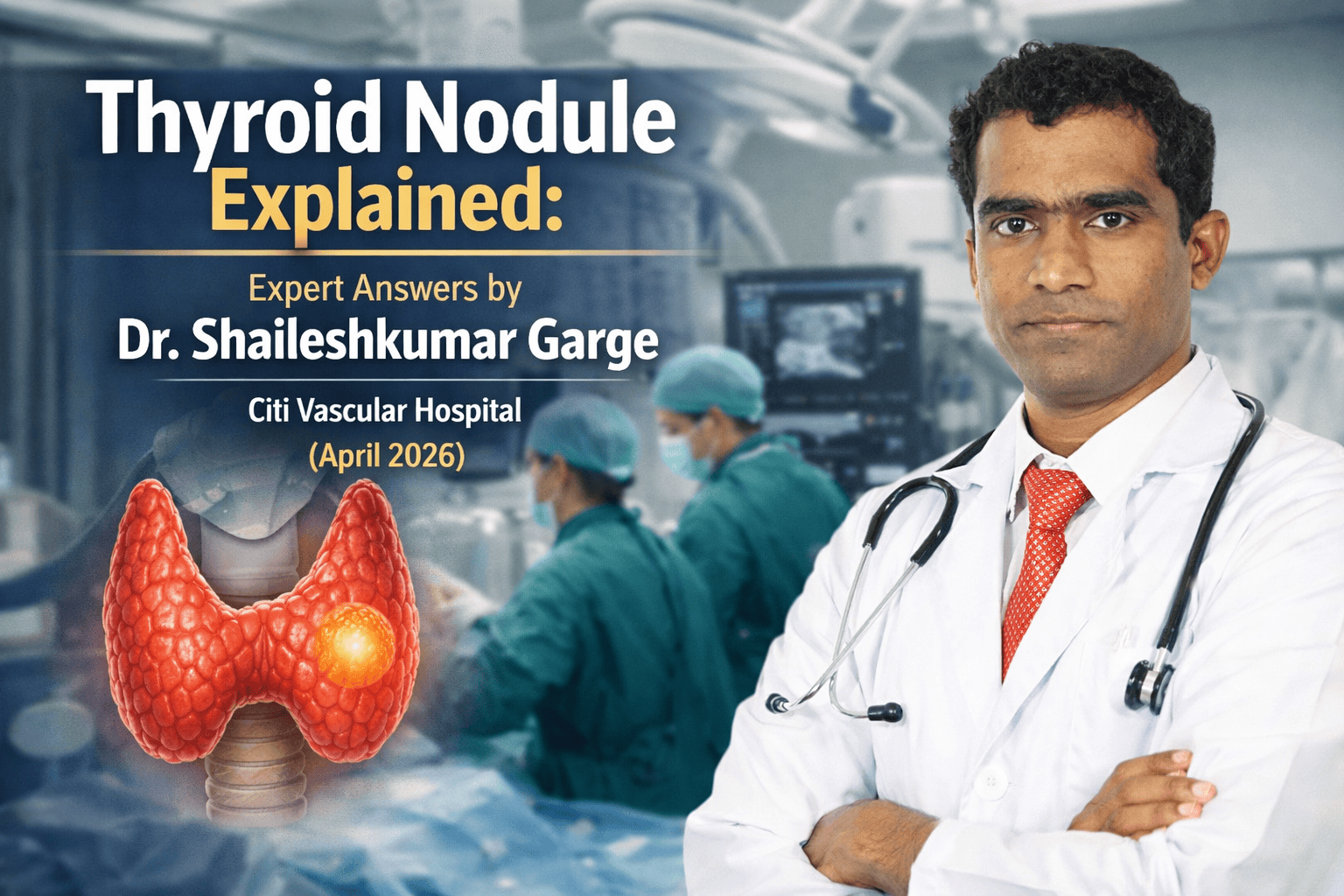
Noticed a lump or swelling in your neck and heard the term “thyroid nodule”? You’re not alone. Thyroid nodules are very common, and in many cases, they are benign and cause no serious harm. In Hyderabad, increasing awareness about thyroid health has led more patients to seek early evaluation and expert opinion.
In this guide, Thyroid Nodule Explained in Hyderabad: Its Causes, Symptoms, Risks & Common Patient Questions Answered by a Thyroid Specialist Dr. Shaileshkumar Garge, we simplify everything you need to know. From understanding the causes of thyroid nodules and recognizing symptoms to watch for, to knowing the risks of cancer and when further tests are needed, this article walks you through each step. Whether you are newly diagnosed or exploring treatment options in Hyderabad, this introduction will help you feel informed, reassured, and ready to discuss your next steps with a thyroid specialist.
A thyroid nodule is simply a lump or abnormal growth within the thyroid gland, located at the base of your neck. These nodules can be:
Solid or fluid-filled
Single or multiple
Small or large
Thyroid nodules become more common with age, and some are detected incidentally during imaging performed for other reasons. The likelihood of finding a nodule depends on factors such as age and the method used for examination.
Here’s where things get interesting—there’s no single cause. Instead, several factors can play a role:
Iodine deficiency
Hormonal changes
Thyroid inflammation
Genetic factors
Overgrowth of thyroid tissue
Sometimes, nodules just… happen without a clear reason.
Most thyroid nodules are silent troublemakers—they don’t show obvious symptoms. But when they do, you might notice:
A visible lump in the neck
Difficulty swallowing
Hoarseness in voice
Neck discomfort
Breathing issues (in large nodules)
Let’s address the big concern right away—are thyroid nodules dangerous?
Most thyroid nodules are benign, but some may require further investigation. Ultrasound findings, clinical history and, when indicated, fine-needle aspiration (FNA) help assess whether additional evaluation is needed.
However, proper diagnosis is crucial. Doctors usually recommend:
Ultrasound scan
Fine Needle Aspiration (FNA) biopsy
Blood tests
You should take a closer look if:
The nodule grows rapidly
You experience persistent pain
Voice changes occur
There’s a family history of thyroid cancer
A growing neck lump, persistent hoarseness, difficulty swallowing or breathing, or other concerning symptoms should be assessed by a qualified medical professional.
Choosing the right specialist can make or break your treatment experience. Here’s why many patients trust Dr. Shaileshkumar Garge:
✅ Expertise in minimally invasive thyroid treatments
✅ Advanced diagnostic tools and imaging
✅ Patient-first, transparent approach
✅ Focus on non-surgical options like RFA (Radiofrequency Ablation)
✅ Located in KPHB, making access easy for Hyderabad patients
Patients considering thyroid nodule treatment should discuss the potential benefits, limitations, risks and expected recovery associated with each suitable option with their treating specialist.
Treatment Option |
Procedure Type |
Recovery Time |
Scarring |
Best For |
Observation |
No procedure |
None |
None |
Small, harmless nodules |
Medication |
Non-invasive |
Ongoing |
None |
Hormonal imbalance cases |
Surgery (Thyroidectomy) |
Invasive |
2–4 weeks |
Yes |
Large or cancerous nodules |
RFA (Radiofrequency Ablation) |
Minimally invasive |
1–2 days |
No |
Benign nodules with symptoms |
RFA is gaining popularity in 2026 because it avoids surgery and offers quicker recovery.
➡ Surgical intervention may be requiredDetection of Thyroid Nodule
↓
Ultrasound Scan
↓
Benign or Suspicious?
↓ ↓
Benign Suspicious
↓ ↓
Observe / RFA Biopsy (FNA)
↓
Benign Malignant
↓ ↓
RFA Surgery
Want the best possible outcome? Keep these practical tips in mind:
Don’t ignore a neck lump—even if it’s painless
Get regular thyroid checkups if you’re at risk
Follow your doctor’s advice—self-diagnosis rarely helps
Maintain a balanced iodine intake
Ask about minimally invasive options like RFA
And here’s a big one—early detection leads to simpler treatment. Always.
Many thyroid nodules are benign. However, assessment is important to identify nodules that may need further investigation or treatment.
Some nodules may decrease in size, while others remain stable or grow. Changes vary, so follow-up should be based on clinical advice.
No. Depending on the diagnosis and symptoms, management may involve observation, medication for an associated thyroid condition, surgery or RFA for selected benign nodules.
Assessment commonly includes clinical examination, thyroid ultrasound and blood tests. FNA may be recommended depending on the nodule's features and size.
Options include observation, medication for specific thyroid conditions, surgery and radiofrequency ablation for selected benign nodules. The appropriate option depends on individual clinical findings.
No. RFA is considered for selected nodules after appropriate evaluation. Its suitability depends on the diagnosis, ultrasound findings, symptoms and other clinical factors. Potential benefits, risks and follow-up requirements should be discussed with the treating specialist.
Book your Appointment here: | Appoinment: |Call +91-7032508468| Whatsapp:+91-7337583901