Pigtail catheter drainage is a minimally invasive, image-guided procedure used to drain abscesses and abnormal fluid collections from the abdomen, pelvis, chest, or other areas.
At Citi Vascular Centre, Hyderabad, image-guided drainage is performed by an experienced interventional radiology team based on the location and nature of the collection.

| Feature | Details |
|---|---|
| Condition | Abdominal abscess, fluid collection, or infected collection |
| Diagnosis | Ultrasound or CT imaging |
| Treatment | Image-guided Pigtail Catheter Drainage |
| Procedure | Minimally invasive — small skin puncture and catheter placement |
| Anaesthesia | Usually local anaesthesia |
| Procedure Duration | Typically 20–60 minutes, depending on the collection |
| Hospital Stay | Same-day or short observation in selected cases |
| Stitches / Major Surgery? | No major incision or stitches |
| Available At | Citi Vascular Centre, KPHB Colony, Hyderabad |
Pigtail catheter drainage may be recommended to drain abscesses or localized fluid collections, helping control infection and relieve associated symptoms.
At Citi Vascular Centre in Hyderabad, image-guided pigtail catheter drainage is performed based on the location, size, and nature of the fluid collection and the patient's clinical condition.
A pigtail catheter is a thin, flexible drainage tube — named for its curled or 'pigtail' shaped tip — that is placed inside an abscess or fluid collection to allow continuous drainage. Unlike needle aspiration (which removes fluid in a single session through a needle), the pigtail catheter remains inside the collection for several days, draining into an external bag attached to the tube. This allows ongoing drainage of infected material without the need for repeated needle punctures or open surgical incision.
The procedure is performed under real-time image guidance — ultrasound, CT, or both — so the catheter is placed precisely inside the collection while avoiding bowel, blood vessels, and surrounding organs. At Citi Vascular Centre, KPHB, Hyderabad, Dr. Garge reviews the CT or ultrasound imaging personally before the procedure to confirm the safest access route for each patient's individual anatomy.
|
Feature |
Pigtail Catheter Drainage |
Open Surgical Drainage |
|
Incision |
No — tiny skin puncture only |
Yes — surgical incision |
|
Anaesthesia |
Local anaesthesia + IV sedation |
General or spinal anaesthesia always |
|
Hospital Stay |
Same-day or 1–3 nights typically |
3–5 days or longer |
|
Recovery |
Return to light activity in 3–5 days |
2–4 weeks |
|
Access to Deep Collections |
Excellent — CT/ultrasound guides to deep locations |
Limited by surgical anatomy for very deep collections |
|
Diagnostic Sample |
Yes — fluid sent for culture as standard |
Yes — but often requires general anaesthesia for same access |
|
Repeat Drainage |
Possible through same catheter |
Repeat surgery more complex |
Not every abscess or fluid collection requires a pigtail catheter. The decision is based on the imaging findings, the size and contents of the collection, the patient's clinical condition, and whether the collection is expected to refill or require ongoing drainage. A pigtail catheter is typically preferred when:
The collection is large — too much fluid to remove safely or completely in a single aspiration
The contents are thick pus that requires time to drain through a tube
The collection is likely to continue producing fluid (e.g. post-surgical collection, bile leak, pancreatic fluid)
A single needle aspiration was attempted but the collection has returned or not resolved
Continuous decompression is needed — as in liver abscess, pelvic abscess, or pleural empyema
Ongoing drain output monitoring is required to guide clinical management
Deep collections that cannot be safely drained by simple surgical incision
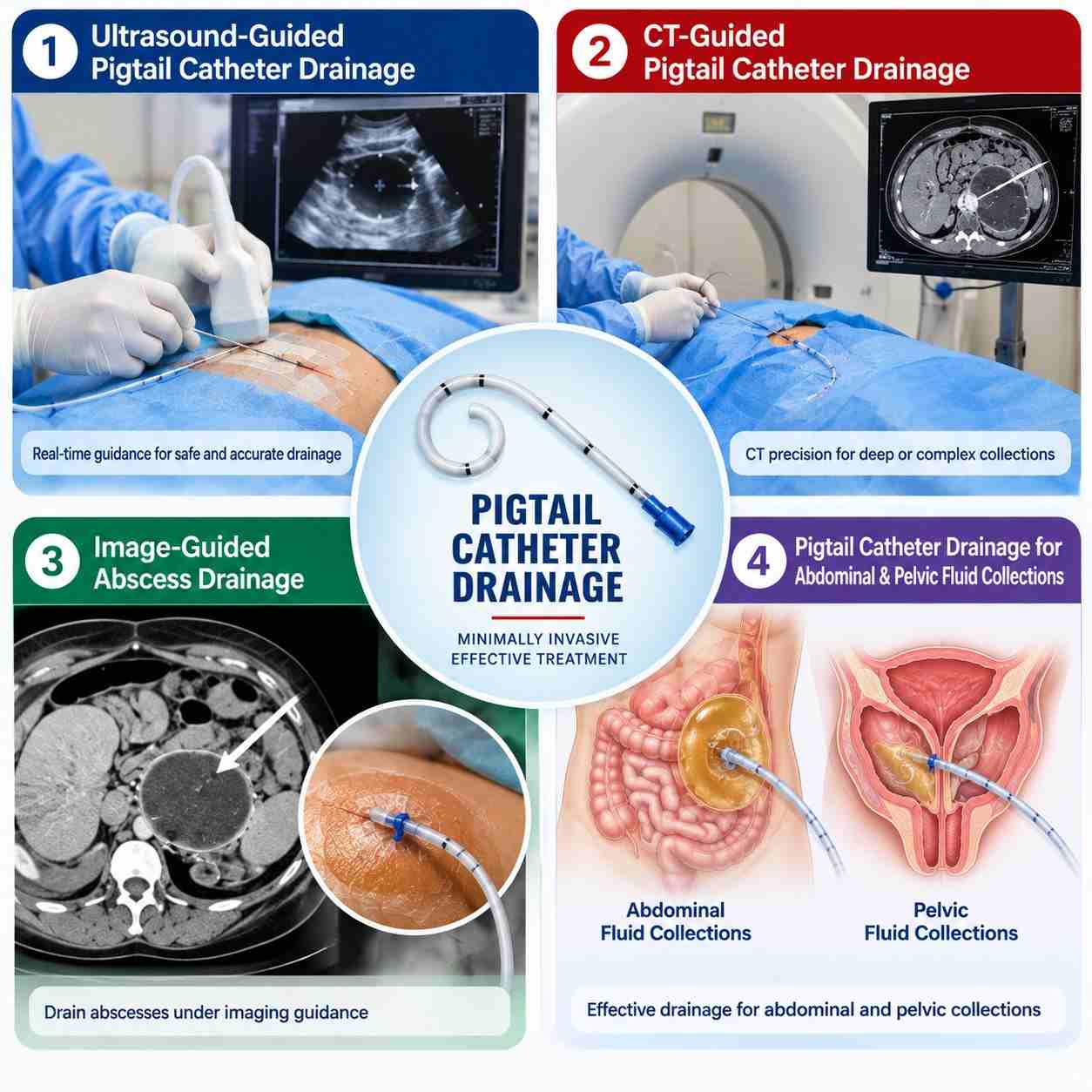
The various Pigtail Catheter Drainage treatment options include:
The appropriate drainage technique depends on the location, size, nature of the fluid collection, imaging findings, and specialist assessment.
The cost of pigtail catheter drainage at Citi Vascular Centre, KPHB, Hyderabad varies depending on the location and complexity of the collection, the guidance modality required (ultrasound vs CT), the duration of catheter stay, hospital admission, and laboratory culture costs. A personalised cost estimate is provided after imaging review:
Ultrasound-guided pigtail catheter placement — typically Rs 10,000–25,000 procedure cost
CT-guided pigtail catheter placement — typically Rs 20,000–40,000 (complex or deep collections)
Hospital ward admission — itemised separately if overnight or multi-day monitoring required
Bacterial culture and sensitivity report — Rs 1,000–3,000
Insurance coverage available when medically indicated — team assists with pre-auth at no extra charge
0% EMI for eligible patients | WhatsApp CT/ultrasound to 73375 83901 for advance review and cost estimate
|
Keep the dressing around the tube clean and dry — change as instructed |
|
Keep the drainage bag positioned below the level of the collection at all times to allow gravity drainage |
|
Do not pull, twist, or place tension on the tube — accidental displacement requires urgent reassessment |
|
Monitor and record daily drain output — note the colour and character (clear, yellow, turbid, thick, blood-stained) |
|
Flush the catheter only if specifically instructed by the treating team — some drains require regular saline flushing to maintain patency |
|
Contact Citi Vascular Centre or the treating team immediately for: sudden stop in drainage | fever returning after initial improvement | increased pain or swelling around the tube | redness, discharge, or odour at the skin entry site | accidental tube displacement |