LAST MEDICALLY REVIEWED:
September 2026 — Dr. Shaileshkumar Garge
Citi Vascular Hospital, KPHB Colony, Road No. 1, Hyderabad, Telangana 500072
⚡ QUICK ANSWER
60+ Varicocele Questions Answered by Dr. Shaileshkumar Garge FRCR (UK)
Varicocele affects 15% of men and 40% with male infertility. Most cases are painless. Treatment is NOT always needed. Non-surgical embolization at Citi Vascular, KPHB achieves 85–90% success. This guide answers every question.
This page answers 60+ frequently asked questions about varicocele — covering every topic from what it is and why it forms, to symptoms, grades, diagnosis tests, fertility effects, treatment options, recovery, and prevention. All answers are medically reviewed by Dr. Shaileshkumar Garge — FRCR (UK), FNVIR (CMC Vellore), EBIR (Spain), Fellowship (USA) — Director and Chief Vascular Physician, Citi Vascular Hospital, KPHB Colony, Hyderabad.
Book a Varicocele Consultation — Citi Vascular Hospital, KPHB, Hyderabad
+91-73375 83901 | WhatsApp | citivascularcentre.com
Dr. Shaileshkumar Garge FRCR (UK) | Non-Surgical Embolization | Same-Day Discharge | Mon–Sat
Book your Appointment here: | Appoinment: |Call +91-7032508468| Whatsapp:+91-7337583901
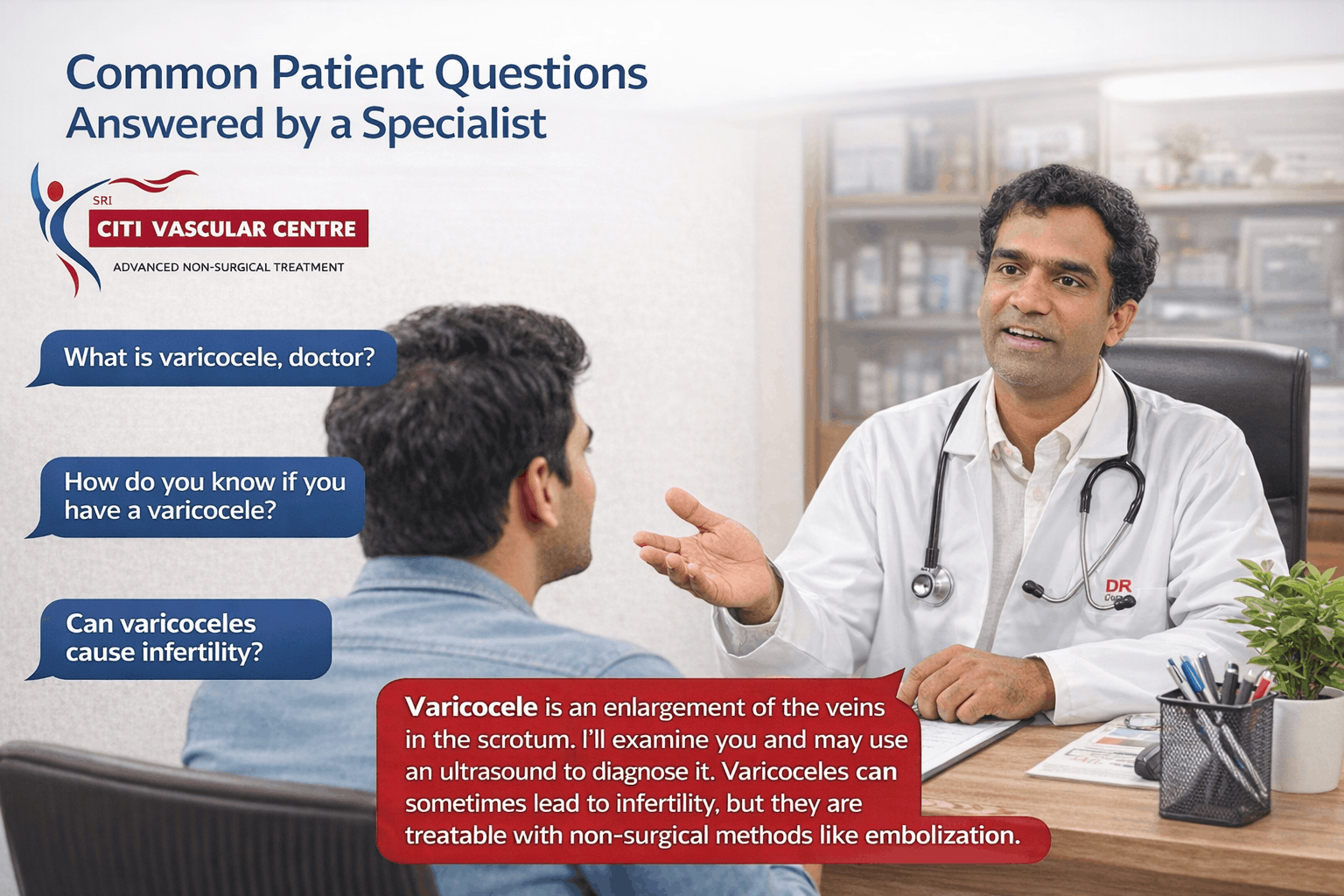
Q1. What exactly is a varicocele?
Varicocele is the abnormal enlargement of the pampiniform plexus — a network of small veins surrounding the testicular artery within the spermatic cord. When venous valves inside the internal spermatic vein become incompetent, blood flows backwards (reflux) and pools, causing the veins to dilate. It is essentially varicose veins of the scrotum.
Q2. What is the pampiniform plexus?
The pampiniform plexus is a network of small veins within the spermatic cord that surround the testicular artery. Its key functions are thermoregulation (maintaining scrotal temperature ~2–4°C below body temperature for optimal spermatogenesis) and venous drainage of the testicle. When these veins enlarge abnormally, they form a varicocele.
Q3. What is the difference between varicocele and varicose veins in the legs?
Both involve incompetent vein valves causing blood pooling and vein enlargement. Varicose veins occur in the legs (saphenous system). Varicocele occurs in the scrotum (pampiniform plexus / internal spermatic vein). The underlying mechanism is identical but the location, consequences, and treatment differ. Varicocele uniquely affects male fertility through elevated scrotal temperature and oxidative stress.
Q4. What is subclinical varicocele?
Subclinical varicocele (Grade 0) is a varicocele that is not detectable on physical examination but is diagnosed on scrotal Doppler ultrasound — showing vein diameter > 3mm and reflux on Valsalva manoeuvre. Subclinical varicocele can still impair semen quality despite being undetectable clinically. Treatment decisions should be based on semen analysis findings, not grade alone.
Q5. What is a bilateral varicocele?
Bilateral varicocele means enlarged veins are present on BOTH the left and right sides simultaneously. It occurs in approximately 30–40% of varicocele cases. The left side is usually more severe. Bilateral varicocele is particularly relevant for treatment planning — embolization can treat both sides in a single session, whereas surgery typically requires two separate procedures.
Q6. Is varicocele common?
Yes. Varicocele affects approximately 15% of all adult men — making it one of the most common conditions in male reproductive health. It is found in up to 40% of men investigated for primary infertility and approximately 80% of men with secondary infertility (those who previously conceived but are now struggling). Most cases are discovered incidentally.
Q7. At what age does varicocele typically develop?
Varicocele most commonly develops during adolescence and early adulthood — typically between ages 15 and 25 years. This coincides with puberty, when blood flow to the testicles increases significantly. However, varicocele can also develop later in adulthood. A new varicocele appearing after age 40 should prompt investigation for a secondary cause such as renal tumour.
Q8. Which side is varicocele most common on?
Varicocele most commonly affects the LEFT testicle (~85–90%) due to the left testicular vein's anatomy — it enters the left renal vein at a near-right angle, creating higher reflux pressure. The RIGHT testicle is affected less commonly. Bilateral varicocele (both sides) occurs in ~30–40% of cases. Isolated right-sided varicocele is rare and warrants investigation for secondary causes.
Q9. What causes varicocele?
The primary cause of varicocele is incompetent venous valves within the internal spermatic vein. Normally, one-way valves prevent blood from flowing backwards. When these valves fail — due to genetic predisposition, anatomical factors, or acquired weakness — blood refluxes toward the testicle, accumulates, and causes progressive vein dilation. This is a structural, not hormonal, problem.
Q10. Why is varicocele more common on the left side?
The left testicular vein drains into the left renal vein at a near-right angle (90°), creating higher venous backpressure and greater tendency for reflux. The right testicular vein drains at an oblique angle directly into the inferior vena cava — lower resistance. Additionally, the left renal vein can be compressed between the aorta and superior mesenteric artery (nutcracker effect), further increasing pressure.
Q11. What is the nutcracker phenomenon in varicocele?
The nutcracker phenomenon occurs when the left renal vein is compressed between the abdominal aorta and the superior mesenteric artery. This compression increases pressure within the left renal vein, which backs up into the left internal spermatic vein — directly contributing to left-sided varicocele formation. It is confirmed on Doppler ultrasound or CT scan and explains some refractory left varicoceles.
Q12. Can cycling or heavy lifting cause varicocele?
Cycling and heavy lifting do not directly cause varicocele — the underlying cause is venous valve incompetence, which is structural. However, these activities may temporarily increase intra-abdominal pressure and venous backflow, making existing varicocele symptoms (pain, heaviness) noticeably worse. If scrotal pain worsens consistently with cycling or weightlifting, a Doppler evaluation is recommended.
Q13. Is varicocele hereditary?
There is evidence of familial clustering — approximately 20–40% of men with varicocele have a first-degree relative (father or brother) with the condition. This suggests a genetic predisposition to connective tissue weakness or venous valve incompetence. However, no single responsible gene has been identified. Varicocele is considered a complex, polygenic, anatomical-predisposition condition rather than a simple Mendelian inherited disease.
Q14. Can a secondary cause (tumour) cause varicocele?
Yes. Secondary varicocele occurs when an external mass compresses the spermatic vein — preventing normal venous drainage. Causes include renal cell carcinoma (kidney cancer), retroperitoneal lymph node enlargement, or pelvic tumours. A new RIGHT-SIDED varicocele, or any varicocele that does NOT reduce on lying down, in a man over 40, is a red flag requiring abdominal imaging to exclude secondary causes.
Q15. Can increased body weight or obesity cause varicocele?
Excess abdominal weight increases intra-abdominal pressure chronically, which can elevate venous backpressure in the spermatic vein — worsening reflux in men with already-incompetent venous valves. Obesity is an aggravating factor, not a primary cause. Normalising body weight may reduce symptom severity but will not resolve established varicocele. Treatment of the underlying venous incompetence is still required.
Q16. Can varicocele cause lower abdominal or groin pain?
Yes. Some men with varicocele experience a referred aching sensation in the lower abdomen, groin, or inner thigh — not just in the scrotum. This is because the spermatic cord, which contains the pampiniform plexus, runs through the inguinal canal in the groin. Persistent lower abdominal or groin pain in young men warrants scrotal Doppler evaluation to exclude varicocele.
Q17. Can varicocele cause back pain?
Varicocele does not directly cause back pain. However, left-sided varicocele associated with nutcracker phenomenon (left renal vein compression) can occasionally cause left flank discomfort that may be mistaken for back pain. If back pain is the primary complaint, other causes (musculoskeletal, renal) should be investigated first. Back pain is not a typical varicocele symptom.
Q18. Can varicocele cause leg pain or swelling?
No. Varicocele affects the scrotal veins only and does not cause leg pain or leg swelling — those symptoms suggest deep vein thrombosis, varicose veins of the legs, or vascular insufficiency, which are entirely different conditions. Leg vascular symptoms should be assessed separately. Citi Vascular Hospital, KPHB, also treats varicose veins and DVT as separate conditions.
Q19. Does varicocele always cause pain?
No. The majority of men with varicocele have no pain whatsoever. Most varicoceles are discovered incidentally during a fertility workup, routine physical examination, or when an ultrasound is performed for another reason. Pain is present in only a minority of men — it is described as a dull ache, heaviness, or dragging sensation that worsens with prolonged standing or physical exertion.
Q20. Can varicocele cause fatigue or generalised weakness?
Varicocele itself does not directly cause fatigue or systemic weakness. However, if varicocele reduces testosterone production in some men over time (through impaired Leydig cell function), low testosterone symptoms — including fatigue, reduced energy, and reduced motivation — may be indirectly experienced. Hormonal testing alongside Doppler evaluation is recommended when these systemic symptoms accompany varicocele.
Q21. Can varicocele be felt by the patient themselves?
Grade III varicoceles can often be felt as a soft, irregular, worm-like mass in the left scrotum — especially noticeable while standing. Many patients describe this as a 'bag of worms' sensation. Grade I and II varicoceles may not be self-palpable. Any new scrotal mass or change in scrotal texture should prompt specialist evaluation — not all scrotal masses are varicoceles.
Q22. Is varicocele visible to the naked eye?
Grade III varicocele (the largest grade) is visually apparent — enlarged veins are visible through the scrotal skin when the patient stands. This is the 'bag of worms' appearance. Grades I and II are not typically visible but may be palpable. Varicocele visibility improves when standing and often disappears when lying flat — this distinguishes varicocele from solid scrotal masses.
Q23. Can varicocele cause erectile dysfunction?
Varicocele is not a direct cause of erectile dysfunction (ED). Erections depend on penile blood flow, nerve function, and psychology — none of which are directly impaired by varicocele. However, if varicocele causes significant testosterone reduction or fertility-related psychological stress, sexual confidence and libido may be indirectly affected. A hormonal assessment and sexual health consultation are advisable when ED accompanies varicocele.
Q24. What is the Valsalva manoeuvre test for varicocele?
The Valsalva manoeuvre is performed by asking the patient to take a deep breath and strain — as if bearing down or forcing against a closed airway. This increases intra-abdominal pressure, impeding venous return and temporarily filling the pampiniform plexus. On Doppler ultrasound, this manoeuvre makes the reflux (backflow) visible even in smaller varicoceles that might not be detectable otherwise.
Q25. What is the difference between scrotal Doppler USG and standard testicular ultrasound?
Standard testicular ultrasound assesses testicular size, texture, and anatomy — it identifies masses, cysts, and structural abnormalities. Scrotal Doppler ultrasound additionally measures blood flow velocity, identifies venous reflux, maps vein diameter (> 3mm = varicocele), and grades the severity. For varicocele diagnosis and treatment planning, Doppler USG is the gold standard — standard ultrasound alone is insufficient.
Q26. Can a blood test diagnose varicocele?
No. There is no blood test that diagnoses varicocele. Blood tests may be used alongside varicocele evaluation for hormonal assessment (FSH, LH, testosterone) and fertility workup (semen analysis does not require blood). The definitive diagnosis requires physical examination + scrotal Doppler ultrasound. Blood tests support the assessment of the varicocele's impact but cannot detect the enlarged veins themselves.
Q27. What is the sperm DNA fragmentation index and why does it matter in varicocele?
Sperm DNA Fragmentation Index (DFI) measures the percentage of sperm with broken or damaged DNA strands. Varicocele increases DFI through oxidative stress and elevated scrotal temperature. High DFI (> 25–30%) is associated with poor embryo quality, implantation failure, and recurrent miscarriage even with IVF/ICSI. DFI testing is recommended for men with varicocele + infertility, especially before assisted reproduction.
Q28. Can varicocele be diagnosed by self-examination?
Large Grade III varicoceles can be self-detected by feel — a soft, irregular, painless mass in the left scrotum while standing that disappears when lying flat. However, clinical diagnosis requires a specialist physical examination and Doppler ultrasound to confirm diagnosis, grade severity, and plan treatment. Do not self-diagnose or self-manage. Consult Dr. Garge at Citi Vascular Hospital, KPHB, for an accurate assessment.
Q29. Does varicocele grade predict fertility impact?
No — grade does NOT reliably predict fertility impact. Multiple studies show that subclinical (Grade 0) varicoceles can significantly impair semen parameters, while some Grade III varicoceles have minimal effect on sperm quality. Semen analysis (count, motility, morphology, DNA fragmentation) is the essential measurement for fertility impact assessment — not the clinical grade alone.
Q30. Can varicocele grade worsen over time?
Yes. Varicocele is a progressive condition in many cases. The underlying cause — venous valve incompetence — is a structural problem that typically does not self-correct. Over months to years, veins can progressively dilate, testicular volume can decrease (atrophy), and semen quality can decline. This is one reason early evaluation and, when indicated, prompt treatment is clinically important.
Q31. Does Grade III varicocele always need treatment?
Not automatically. Grade III varicocele is a strong indication for evaluation, but treatment depends on symptoms, semen analysis results, and fertility goals. A man with Grade III varicocele, normal semen parameters, and no symptoms or fertility goals may be appropriately observed. A man with Grade III varicocele + abnormal semen + infertility should be offered treatment. Grade alone is insufficient to decide.
Q32. What is Grade 0 or subclinical varicocele — should it be treated?
Grade 0 (subclinical) varicocele is diagnosed on Doppler USG only — not detectable on physical examination. Subclinical varicocele in a man with normal semen parameters and no symptoms typically does not require treatment — watchful waiting is appropriate. However, if semen analysis is abnormal and no other cause is identified, treatment of subclinical varicocele may still be considered in fertility workup.
Book your Appointment here: | Appoinment: |Call +91-7032508468| Whatsapp:+91-7337583901
Q33. Can varicocele cause azoospermia (zero sperm)?
Yes, but it is uncommon. Varicocele is a well-recognised cause of non-obstructive azoospermia — particularly in men with significant bilateral varicocele and testicular atrophy. In some cases, treating varicocele in azoospermic men can result in sperm returning to the ejaculate — making natural conception or IVF/ICSI possible. This must be assessed individually with hormonal testing and testicular biopsy planning.
Q34. Does varicocele treatment improve IVF/ICSI success rates?
Yes, in selected patients. Treating varicocele 3–6 months before IVF/ICSI can improve sperm count, motility, morphology, and DNA fragmentation — all of which directly affect embryo quality and implantation rates. Multiple fertility societies (ASRM, EAU) now recommend varicocele treatment before ART in men with clinical varicocele + abnormal semen + female partner with no untreatable infertility.
Q35. Can varicocele cause secondary infertility (previously conceived)?
Yes — and varicocele is the most common cause of secondary infertility. Up to 80% of men evaluated for secondary infertility have varicocele — the highest prevalence of any male infertility subgroup. Varicocele is a progressive condition; a man who previously conceived naturally can develop worsening semen parameters over years as untreated varicocele progresses and testicular function gradually declines.
Q36. Does varicocele affect testosterone levels?
In some men, yes. Long-standing varicocele impairs Leydig cell function through chronic venous congestion, elevated scrotal temperature, and oxidative stress — reducing testosterone synthesis. Studies show some men with varicocele have below-normal testosterone that improves after treatment. However, testosterone deficiency is not present in all varicocele patients. Hormonal testing (serum testosterone, FSH, LH) is recommended when suspected.
Q37. How long after varicocele treatment does semen improve?
Semen parameter improvement after varicocele treatment (embolization or surgery) takes 3–6 months — because human spermatogenesis takes approximately 74 days from germ cell to mature sperm. The first post-treatment semen analysis should be performed at 3 months to capture early changes. The definitive assessment is at 6 months. Most fertility improvement, if it occurs, is measurable within this window.
Q38. Can varicocele affect sperm morphology (shape)?
Yes. Varicocele impairs the testicular environment — elevated temperature, oxidative stress, and poor nutrition to developing sperm cells — resulting in abnormal sperm morphology (malformed shapes). Morphology abnormality (teratospermia) is a common finding on semen analysis in men with varicocele. Post-treatment morphology improvement at 3–6 months is an expected and measurable outcome of successful embolization.
Q39. Does varicocele cause premature ejaculation?
No. Varicocele does not directly cause premature ejaculation. These are distinct conditions with different mechanisms. However, varicocele-related scrotal pain, fertility anxiety, or reduced sexual confidence may indirectly affect sexual performance and ejaculatory control in some men. A sexual health consultation is advisable if premature ejaculation accompanies varicocele symptoms — they likely represent two independent concerns.
Q40. Can a man with varicocele father children without treatment?
Yes — many men with varicocele father children naturally without any treatment. Most men with varicocele are not infertile. Fertility is affected in a proportion of men depending on varicocele severity, bilateral involvement, age, and individual testicular reserve. Treatment is reserved for men with abnormal semen analysis + fertility concerns + clinical varicocele — not for all men with varicocele.
Q41. What happens to sperm quality if varicocele is left untreated for years?
Varicocele is a progressive condition. Multiple longitudinal studies show progressive decline in semen parameters over years in untreated symptomatic varicocele — particularly in bilateral disease. Testicular volume may decrease progressively (atrophy). The longer treatment is delayed after symptoms or semen abnormality is established, the greater the risk of permanent testicular damage. Early treatment produces better fertility outcomes.
Q42. Can sperm quality return to normal after varicocele embolization?
Sperm quality can significantly improve after varicocele embolization — with 60–70% of men showing measurable improvement in count, motility, or morphology at 6-month semen analysis. Whether parameters fully normalise depends on baseline values, duration of varicocele, and degree of testicular atrophy. Men with more preserved testicular function at treatment generally show the greatest post-embolization improvement.
Q43. What happens if varicocele is left untreated?
If left untreated, varicocele may cause: progressive testicular atrophy (shrinkage), declining semen parameters, worsening fertility outcomes, persistent scrotal pain, and rarely testosterone deficiency over years. Not all untreated varicoceles progress — some remain stable. However, symptomatic varicocele with abnormal semen analysis or testicular atrophy warrants treatment. Annual monitoring with Doppler USG and semen analysis is essential for untreated cases.
Q44. Can varicocele be treated with medications?
No medication directly treats or cures varicocele. Medications cannot repair incompetent venous valves or eliminate the venous reflux causing varicocele. NSAIDs (ibuprofen, diclofenac) and scrotal support may temporarily reduce pain symptoms. Antioxidant supplements (vitamin C, vitamin E, CoQ10, selenium) may partially reduce oxidative stress on sperm but do not treat the varicocele itself. Definitive treatment requires embolization or surgery.
Q45. What is the difference between varicocele embolization and sclerotherapy?
Both are non-surgical catheter-based treatments. Embolization uses mechanical coils (and/or foam) to permanently physically block the spermatic vein. Sclerotherapy uses chemical agents (sclerosants) injected to cause chemical vein closure. Combined technique (coils + sclerosant foam) treats the main vessel and collateral branches simultaneously — achieving the lowest recurrence rates. At Citi Vascular KPHB, all three techniques are available.
Q46. How long does varicocele embolization last?
Varicocele embolization is designed as a permanent, long-term treatment. The embolized vein is permanently blocked — it does not reopen. The embolic coils or sclerosant-induced scar tissue remain permanently in place. The overall recurrence rate is approximately 5–10% at 2 years, usually due to collateral vein development — not recanalization of the treated vessel. Combined technique has the lowest long-term recurrence.
Q47. Can varicocele recur after embolization?
Yes — recurrence occurs in approximately 5–10% of cases at 2 years after embolization, typically due to collateral venous channels developing around the embolized segment. This is more common when small branch veins were not treated during the initial procedure. Combined coil + sclerosant technique reduces recurrence. Recurrence is confirmed on follow-up Doppler USG and can usually be re-treated with repeat embolization.
Q48. What is post-embolization syndrome after varicocele treatment?
Post-embolization syndrome is a normal inflammatory response that occurs after varicocele embolization. Symptoms include mild fever (up to 38°C), pelvic or flank ache, nausea, and fatigue for 2–5 days after the procedure. It results from the body's immune response to the embolized vein tissue. It is self-limiting, managed with paracetamol and rest, and resolves completely within a week in most patients.
Q49. Can varicocele embolization improve testosterone levels?
In some men, yes. Studies show testosterone levels improve post-embolization in men who had documented low testosterone associated with varicocele. By relieving venous congestion and reducing scrotal temperature, embolization can improve Leydig cell function. The improvement is typically modest and not immediate — hormonal follow-up at 3 and 6 months post-embolization is recommended when baseline testosterone was low.
Q50. Which is better for varicocele — embolization or microsurgery?
Both achieve comparable outcomes: 85–90% clinical success. Embolization advantages: no incision, local anaesthesia, same-day discharge, 2–3 day recovery, bilateral same session, < 1% hydrocele risk. Microsurgery advantages: marginally lowest recurrence (~1–5%). Embolization is preferred for bilateral, recurrent post-surgical, and time-sensitive cases. Microsurgery may suit specific anatomical situations. Both options discussed openly at Citi Vascular KPHB.
Q51. Can varicocele treatment cure infertility?
Varicocele treatment improves the conditions for fertility — it does not guarantee pregnancy. Treatment reduces scrotal temperature, oxidative stress, and DNA fragmentation — allowing 60–70% of men to show semen improvement. Whether pregnancy occurs also depends on female partner fertility, female age, and how long the varicocele was present. Treatment significantly improves natural conception chances and IVF success rates in appropriate candidates.
Q52. When does varicocele NOT need treatment?
Varicocele does NOT need treatment when: semen analysis is normal, there are no fertility concerns, testicular size is symmetric, and symptoms (pain, heaviness) are absent or minimal. In this scenario, watchful waiting with annual Doppler + semen analysis monitoring is the appropriate management. Treatment should not be performed prophylactically in asymptomatic men with normal semen and no family planning intentions.
Q53. Can I exercise after varicocele embolization?
Light walking is acceptable from Day 2. Return to gym, cycling, and strenuous exercise typically from Day 7–10 after embolization. Heavy lifting and contact sports should be avoided for 2 weeks. For surgical varicocelectomy, full exercise typically resumes at 3–4 weeks. Follow specific instructions from Dr. Garge's team at Citi Vascular, KPHB, as individual recovery timelines vary.
Q54. When can I ride a bicycle after varicocele treatment?
After embolization, cycling is typically safe to resume at Day 7–10. After surgical varicocelectomy, cycling is usually restricted for 3–4 weeks as the groin or scrotal incision heals. Cycling places direct pressure on the perineum and scrotal area — returning too early may increase discomfort. If pain recurs on cycling after clearance, reduce frequency and consult Dr. Garge.
Q55. What is the best sleeping position after varicocele embolization?
Sleeping on your back (supine) with a small pillow supporting the scrotal area is recommended for the first 2–3 days after embolization — this reduces scrotal pressure and improves venous drainage. Avoid sleeping on your stomach (prone) in the first week. Normal sleeping positions can be resumed once the acute soreness resolves, typically within 3–5 days of embolization.
Q56. Is it normal to feel scrotal heaviness for months after varicocele embolization?
Mild residual scrotal heaviness for 4–8 weeks after embolization is normal and does not indicate treatment failure — it takes time for the embolized vein to fibrose (scar down) and for venous congestion to fully resolve. Progressive improvement over 6–12 weeks is expected. If heaviness is increasing rather than decreasing after 8 weeks, a follow-up Doppler ultrasound should be arranged with Dr. Garge.
Q57. What foods or diet can help with varicocele?
No food or diet cures varicocele — the underlying cause is structural (venous valve incompetence). However, antioxidant-rich foods may reduce oxidative stress on sperm: leafy greens (folate), berries (polyphenols), nuts (selenium, vitamin E), oily fish (omega-3), and colourful vegetables. Staying hydrated, reducing alcohol, and avoiding smoking also support testicular health. These are supportive measures, not treatments.
Q58. Can tight underwear or clothing cause varicocele?
Tight underwear does not cause varicocele — the cause is venous valve incompetence, not external compression. However, supportive (not constrictive) underwear is recommended for men with symptomatic varicocele to reduce scrotal traction and minimise pain during daily activities. Loose or unsupportive underwear may worsen discomfort. Scrotal support is a comfort measure — it does not treat the varicocele itself.
Q59. Can ice application help varicocele pain?
Ice packs applied to the scrotum for 10–15 minutes at a time may temporarily relieve scrotal pain by causing vasoconstriction and reducing inflammation — particularly after prolonged standing or exercise. This is a comfort measure only — it does not treat or reduce the varicocele. If varicocele pain is affecting daily life, specialist evaluation and definitive treatment planning is the appropriate step.
Q60. Can yoga or pelvic exercises help varicocele?
No yoga or exercise cures or physically reduces varicocele. Certain yoga poses that elevate the legs (legs-up-the-wall / Viparita Karani) may temporarily improve venous drainage and reduce scrotal heaviness. However, these are comfort measures — the structural cause (incompetent venous valves) cannot be addressed by exercise. Men with persistent pain or fertility concerns should seek specialist evaluation.
Q61. What is the difference between varicocele and hydrocele?
Varicocele is an enlargement of scrotal veins around the testicle. Hydrocele is an accumulation of fluid in the sac surrounding the testicle. Varicocele feels like a 'bag of worms' (soft, irregular veins). Hydrocele feels like a smooth, fluid-filled swelling that transilluminates (light passes through) on examination. Both are diagnosed by scrotal ultrasound. They have different causes, treatments, and clinical significance.
Q62. What is the difference between varicocele and epididymal cyst?
Epididymal cyst (spermatocele) is a smooth, round, well-defined cyst in the epididymis — usually painless and benign. Varicocele is a collection of dilated, tortuous veins with a soft, worm-like feel. Both are diagnosed by scrotal ultrasound. Epididymal cysts rarely require treatment. Varicocele requires treatment when causing pain, infertility, or testicular atrophy. They are entirely different conditions.
Q63. Can varicocele be confused with inguinal hernia?
Yes — varicocele and inguinal hernia can both cause groin or scrotal discomfort. Hernia involves protrusion of abdominal contents (fat or bowel) through the inguinal canal — may produce a bulge that increases with straining. Varicocele involves venous enlargement within the scrotum. Clinical examination and scrotal/inguinal ultrasound differentiate the two. Both conditions can coexist in the same patient.
Q64. Is varicocele related to kidney problems?
Standard varicocele is not caused by kidney disease. However, the connection between the left testicular vein and the left renal vein is anatomically significant — nutcracker syndrome (left renal vein compression) can cause both left varicocele AND left flank pain / haematuria. Right-sided varicocele can be caused by a right renal tumour compressing the spermatic vein. Renal investigation is warranted in atypical presentations.
Q65. What is the difference between varicocele and testicular torsion?
Testicular torsion is a urological emergency — sudden twisting of the spermatic cord cuts off blood supply to the testicle, causing severe acute pain. Without treatment within 6 hours, the testicle may be lost. Varicocele causes gradual, dull aching that worsens with activity. Any SUDDEN severe scrotal pain should be treated as torsion until proven otherwise — go to the emergency room immediately.
Q66. Is varicocele dangerous?
Varicocele is not dangerous to life, but it is not entirely benign either. Untreated varicocele can progressively cause testicular atrophy (shrinkage), declining sperm quality, male infertility, and in some men, testosterone deficiency. Most varicoceles are manageable — the key is early evaluation, semen analysis, and treatment when indicated. Varicocele does not cause cancer and is not life-threatening.
Q67. Can varicocele be cured without surgery?
Yes. Varicocele embolization is a proven non-surgical treatment achieving 85–90% clinical success without any incision, stitches, or general anaesthesia. A 2mm catheter inserted through the wrist or groin permanently blocks the abnormal veins under fluoroscopy guidance. Same-day discharge. 2–3 day return to work. Available at Citi Vascular Hospital, KPHB, Hyderabad — Dr. Shaileshkumar Garge FRCR (UK).
Q68. Does varicocele cause permanent infertility?
Not necessarily. Varicocele is one of the most common CORRECTABLE causes of male infertility. When treated appropriately, 60–70% of men show semen parameter improvement and spontaneous pregnancy rates of 30–45% are reported. Permanent infertility risk is higher when varicocele is bilateral, long-standing, and associated with progressive testicular atrophy. Early treatment produces better long-term fertility outcomes.
Q69. What does varicocele feel like?
Most varicoceles produce no sensation. When symptomatic, varicocele typically feels like a dull, heavy, dragging ache in the left scrotum — worsening after prolonged standing, physical exertion, or by end of day. On self-examination while standing, a Grade III varicocele may feel like a soft, irregular cluster of worms behind the left testicle.
Q70. What happens if varicocele is not treated?
If untreated, varicocele may cause: progressive decline in sperm count, motility, and morphology over years; testicular atrophy (reduction in testicular volume); reduced testosterone in some men; and permanent impairment of fertility potential. However, not all untreated varicoceles progress — some remain stable. Annual monitoring with Doppler USG and semen analysis is essential for untreated symptomatic varicoceles.
Q71. How do I know if I have a varicocele?
Common indicators include: dull scrotal aching worsening with activity; scrotal heaviness; a soft, irregular lump in the left scrotum while standing; testicular size discrepancy; or an abnormal semen analysis result. Definitive diagnosis requires a scrotal Doppler ultrasound by a specialist. Physical examination alone may miss subclinical varicoceles. Book an evaluation at Citi Vascular Hospital, KPHB — +91-73375 83901.
Q72. Is varicocele surgery painful?
Surgical varicocelectomy uses general or spinal anaesthesia — so the surgery itself is not felt. Post-operative pain from the incision (groin or abdomen) typically requires oral painkillers for 5–7 days. Varicocele embolization (the non-surgical alternative) uses local anaesthesia — only a brief sting at injection. Post-embolization discomfort (mild pelvic ache for 1–2 days) is significantly less than post-surgical pain.
Q73. Can varicocele affect both testicles at the same time?
Yes — bilateral varicocele (affecting both left and right testicles) occurs in approximately 30–40% of varicocele cases. The left side is usually more prominent. Bilateral varicocele may cause greater fertility impairment than unilateral disease because both testes are affected. Embolization can treat both sides simultaneously in a single session — a major advantage over surgery, which requires two separate procedures.
Q74. Varicocele vs epididymitis — how are they different?
Varicocele: enlarged veins | gradual onset | dull ache | no fever | affects fertility.
Epididymitis: infection/inflammation of the epididymis | acute onset | significant pain | often with fever and discharge | treated with antibiotics. Epididymitis is an infection; varicocele is a venous structural problem. Both cause scrotal pain but require entirely different treatments.
Q75. Varicocele and male infertility — link explained
Varicocele impairs fertility through: elevated scrotal temperature (1–2°C above optimal, impairing spermatogenesis), increased reactive oxygen species (oxidative DNA damage), impaired Leydig cell testosterone production, and progressive testicular atrophy. Present in ~40% of infertile men. Treating varicocele improves semen parameters in 60–70% and pregnancy rates in ~30–45% of couples.
Q76. Varicocele embolization vs varicocelectomy — which is better?
Comparable success (85–90%). Embolization: no incision, local anaesthesia, same-day discharge, 2–3 day recovery, bilateral in one session, < 1% hydrocele risk. Varicocelectomy (microsurgery): marginally lower recurrence (~1–5%), general anaesthesia, 7–14 day recovery, 2–5% hydrocele risk. Choice depends on anatomy, bilateral disease, recurrence priority, and individual circumstances.
Q77. Best varicocele specialist in Hyderabad
Dr. Shaileshkumar Garge — FRCR (UK), FNVIR (CMC Vellore), EBIR (Spain) — Director and Chief Vascular Physician at Citi Vascular Hospital, KPHB, Hyderabad. 12+ years of interventional radiology | 15,000+ minimally invasive procedures | Non-surgical varicocele embolization specialist | Bilateral same-session | Dedicated Cath Lab. Call +91-73375 83901.
Q78. Varicocele IVF — does treatment before IVF help?
Yes. Multiple fertility guidelines (ASRM, EAU) recommend treating varicocele before IVF/ICSI when: clinical varicocele + abnormal semen + female with treatable/no infertility. Embolization 3–6 months before the IVF cycle reduces sperm DNA fragmentation, improves embryo quality, and can lower the number of IVF cycles required. Some couples conceive naturally after varicocele treatment — avoiding IVF entirely.
Citi Vascular Hospital, KPHB Colony, Road No. 1, Hyderabad — varicocele evaluation, Doppler USG, and embolization available for patients from:
Kukatpally & KPHB — 5 min
Miyapur & Bachupally — 10 min
Hitech City & Madhapur — 20 min
Ameerpet & SR Nagar — 20 min
Gachibowli & Kondapur — 25 min
Secunderabad & Begumpet — 25 min
Kompally, Medchal & Alwal — 20–25 min
Warangal, Nizamabad & AP — outstation welcome
|
Hospital |
Contact |
Hours |
|
Citi Vascular Hospital |
+91-73375 83901 |
KPHB Colony, Road No. 1, Hyderabad, Telangana 500072 | Mon–Sat 9AM–6PM |
|
Online Booking |
citivascularcentre.com |
WhatsApp + online | Same-day consultation available | Free parking |
|
Credential |
Detail |
|
Full Name |
Dr. Shaileshkumar Garge |
|
Qualifications |
MBBS | MD (Mumbai) | DNB (Delhi) | FRCR (UK) | FNVIR (CMC Vellore) | EBIR (Spain/Europe) | Fellowship (North Carolina, USA) |
|
Role |
Director & Chief Vascular Physician | Senior Consultant Interventional Radiologist |
|
Hospital |
Citi Vascular Hospital, KPHB Colony, Road No. 1, Hyderabad, Telangana 500072 |
|
Experience |
12+ years | 15,000+ minimally invasive procedures |
|
✅ |
Varicocele affects 15% of men and 40% with infertility — the most common correctable cause |
|
✅ |
Most varicoceles cause no pain — discovered incidentally on fertility workup or physical exam |
|
✅ |
Grade does NOT predict fertility impact — semen analysis is the essential measurement |
|
✅ |
Non-surgical embolization: 85–90% success | same-day discharge | 2–3 day recovery | no incision |
|
✅ |
Bilateral varicocele treated in ONE embolization session — surgery needs two separate procedures |
|
✅ |
Semen improvement after treatment takes 3–6 months — spermatogenesis cycle = 74 days |
|
✅ |
Available at Citi Vascular Hospital, KPHB, Hyderabad — Dr. Garge FRCR (UK) | +91-73375 83901 |
Still Have Questions? Book a Varicocele Consultation
Citi Vascular Hospital, KPHB Colony, Road No. 1, Hyderabad
Dr. Shaileshkumar Garge | FRCR (UK) | FNVIR (CMC Vellore) | EBIR (Spain) | 12+ Years | 15,000+ Procedures
+91-73375 83901 | WhatsApp Now | citivascularcentre.com
Non-Surgical Embolization | Insurance Assisted | EMI Available | Same-Day Discharge | Mon–Sat 9AM–6PM
Book your Appointment here: | Appoinment: |Call +91-7032508468| Whatsapp:+91-7337583901