LAST MEDICALLY REVIEWED:
June 2026 — Dr. Shaileshkumar Garge
Citi Vascular Hospital, KPHB Colony, Road No. 1, Hyderabad, Telangana 500072
QUICK ANSWER
Enlarged Prostate (BPH) Treatment in Hyderabad — Without Surgery
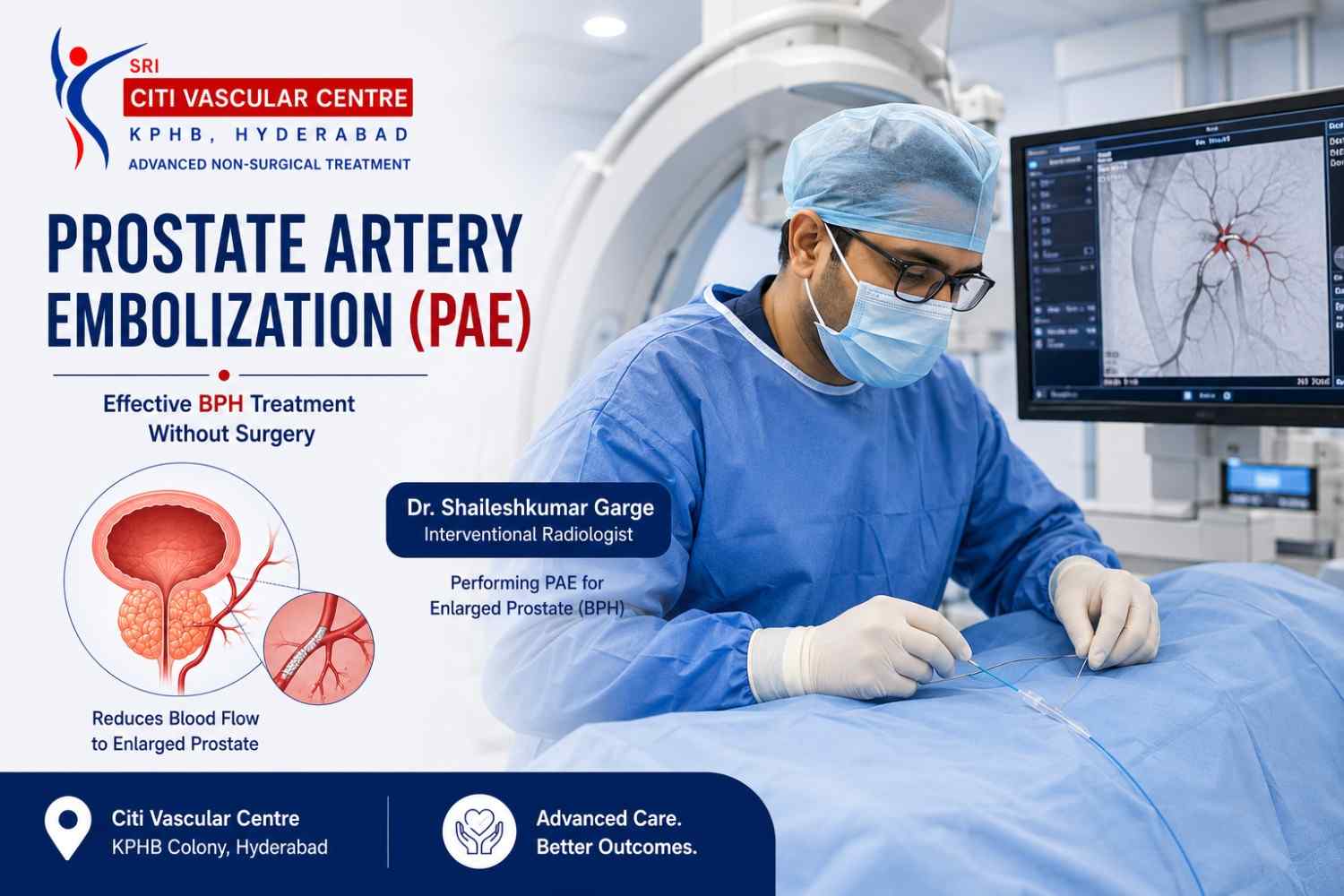
Prostate Artery Embolization (PAE) shrinks the enlarged prostate by blocking its blood supply through a small wrist or groin artery — no surgical incision, no general anaesthesia, no catheter in most cases, no risk to sexual function. Same-day discharge. 80–90% of patients experience significant improvement in urinary symptoms. Dr. Garge FRCR (UK) | Citi Vascular Centre, KPHB, Hyderabad. Call +91-73375 83901.
Prostate artery embolization (PAE) is a minimally invasive image-guided treatment for benign prostate enlargement (BPH). Using a small catheter inserted through the wrist or groin, tiny particles are placed into the arteries supplying the prostate, reducing blood flow and gradually shrinking the gland. This improves urinary symptoms without removing prostate tissue — typically over 4 to 12 weeks — and the improvement is durable, lasting years for most patients. No surgery. No overnight hospital stay. No risk to erection or ejaculation. For the right patient, PAE is now the preferred treatment over TURP (transurethral resection of the prostate) recommended by the International Society of Interventional Oncology, the American Urological Association, and NICE UK in their clinical guidelines.
At Citi Vascular Centre, KPHB Colony, Hyderabad, PAE is performed by Dr. Shaileshkumar Garge — FRCR (UK), FNVIR (CMC Vellore), EBIR (Spain) — one of the most internationally credentialled interventional radiologists in Hyderabad. This page covers everything you need to decide if PAE is right for you.
Tired of BPH symptoms? PAE may be the answer without surgery.
Citi Vascular Centre, KPHB Colony, Hyderabad | Dr. Garge FRCR (UK) | Same-Day Discharge | No Sexual Side Effects
Call +91-73375 83901 | WhatsApp 73375 83901 | citivascularcentre.com
BPH stands for Benign Prostatic Hyperplasia — the non-cancerous enlargement of the prostate gland that affects almost all men as they age. The prostate surrounds the urethra (the tube through which urine passes from the bladder), so when it enlarges, it progressively squeezes the urethra — reducing urine flow, causing incomplete bladder emptying, and forcing the bladder to work harder to push urine out.
The symptoms of BPH are collectively called Lower Urinary Tract Symptoms (LUTS) — and they range from mildly inconvenient to life-disrupting. Many men accept these symptoms as 'normal ageing' for years before seeking help — by which time the bladder has often been under chronic strain, and the symptoms are significantly more severe than they needed to become.
|
Symptom Category |
What Patients Experience |
Impact on Daily Life |
|
Frequency — day and night |
Needing to urinate every 1–2 hours during the day | Waking 2–5 times per night (nocturia) |
Sleep deprivation | Daytime fatigue | Difficulty working | Partner sleep disruption |
|
Urgency |
Sudden, intense urge to urinate that is difficult to defer — sometimes resulting in leakage |
Social embarrassment | Anxiety about being far from toilets | Reduced outdoor activities |
|
Weak stream |
Slow, weak urine flow. Straining to initiate. Flow starts and stops (intermittency). |
Time spent at the toilet. Frustration. Post-void dribbling. |
|
Incomplete emptying |
Sensation of incomplete bladder emptying after urination — residual urine in bladder |
Frequent return to toilet. Recurrent urinary tract infections from retained urine. |
|
Hesitancy |
Long wait between attempting to urinate and the flow beginning |
Uncomfortable in public toilets. Anxiety in social situations. |
|
In severe untreated cases |
Acute urinary retention — complete inability to pass urine. Bladder and kidney damage from chronic retention. |
Emergency catheterisation. Hospital admission. Potential long-term bladder or kidney damage. |
BPH is progressive. Without treatment, the prostate typically continues to enlarge over years — meaning symptoms that are currently manageable with medication will almost always worsen without definitive intervention. The earlier BPH is treated when it begins to impact quality of life, the better the outcomes. Do not wait for acute retention before seeking specialist assessment.
When Should You Consult a Doctor for Enlarged Prostate?
You should consult a doctor for enlarged prostate if you have following symptoms:
waking more than twice nightly
weak urine stream
recurrent urine infection
urinary retention
blood in urine
medications no longer working
Prostate Artery Embolization is a minimally invasive procedure performed by an interventional radiologist — specifically by a specialist trained in catheter-based techniques who navigates through the body's arterial system using real-time X-ray imaging (fluoroscopy) and specialised contrast dye to identify and treat the target arteries.
In PAE, Dr. Garge makes a 2mm skin puncture at the wrist (radial artery) or groin (femoral artery) and threads a hair-thin catheter to the prostate arteries using real-time angiography imaging. Once the arteries supplying the enlarged portions of the prostate are identified, tiny microspheres (embolic particles, approximately 100–300 microns in diameter) are delivered through the catheter to block blood flow selectively to the enlarged prostate tissue. The prostate tissue that loses its blood supply undergoes gradual shrinkage — reducing the pressure on the urethra and allowing normal urinary function to gradually restore.
The groin approach is preferred at Citi Vascular Centre when anatomy permits. The procedure takes approximately 60 to 90 minutes and is performed under local anaesthesia with intravenous sedation so that patients are comfortable and relaxed throughout without the need for general anaesthesia.
|
PAE Key Facts |
Detail |
|
Procedure Type |
Minimally invasive interventional radiology procedure — catheter-based, no surgical incision |
|
Performed By |
Interventional Radiologist — Dr. Shaileshkumar Garge FRCR (UK) |
|
Anaesthesia |
Local anaesthesia + intravenous sedation. No general anaesthetic required. |
|
Access Point |
Femoral artery (groin) | Radial artery (wrist) |
|
Procedure Duration |
60–90 minutes |
|
Hospital Stay |
Day-care to overnight — most patients go home the same day or next morning |
|
Catheter After Procedure |
Usually NOT required post-PAE. Most patients void normally. |
|
Risk to Sexual Function |
No — PAE preserves erection and ejaculation. No sexual side effects in the vast majority of patients. |
|
Symptom Improvement Timeline |
Gradual improvement over 4–12 weeks as prostate shrinks. Most patients notice significant change by 6 weeks. |
|
Success Rate |
80–90% of patients achieve significant improvement in IPSS urinary symptom score at 1 year |
|
Prostate Volume Reduction |
20–40% reduction in prostate volume on follow-up MRI at 3–6 months |
4. WHY PAE INSTEAD OF SURGERY? — THE HONEST COMPARISON
For decades, the standard surgical treatment for BPH was TURP — transurethral resection of the prostate — where a resectoscope is passed through the urethra and the surgeon removes enlarged prostate tissue under general or spinal anaesthesia. TURP is effective, but it comes with a well-documented profile of sexual side effects — retrograde ejaculation (semen travels into the bladder rather than out during orgasm) occurs in 65–90% of patients after TURP, and erectile dysfunction in a smaller but significant proportion. PAE offers comparable urinary symptom improvement with a fundamentally different side effect profile.
|
Factor |
TURP Surgery |
PAE — Prostate Artery Embolization |
|
Anaesthesia |
General or spinal anaesthesia |
Local anaesthesia + intravenous sedation only |
|
Surgical Incision |
Resectoscope passed through urethra — urethral trauma |
2mm skin puncture only — no surgical wound |
|
Hospital Stay |
2–4 days |
Day-care — most patients home same day or next morning |
|
Urinary Catheter |
Required post-procedure for 1–3 days |
Usually NOT required post-PAE |
|
Retrograde Ejaculation |
65–90% of patients — permanent |
< 5% — rare side effect. PAE specifically preserves ejaculatory function. |
|
Erectile Dysfunction |
5–15% risk |
No documented increase in erectile dysfunction with PAE |
|
Return to Normal Activities |
3–4 weeks |
7–14 days for most patients |
|
Suitable for Very Large Prostates (> 80g) |
Technically challenging — risk increases with size |
PAE particularly effective for very large prostates where surgical risk is higher |
|
Suitable for High Surgical Risk Patients |
General anaesthesia risk significant for patients with cardiac, respiratory or renal disease |
Local anaesthesia only — suitable for patients who cannot safely undergo general anaesthesia |
|
NICE UK / AUA Status |
Established standard — but second-line for PAE-eligible patients |
Recommended alternative — first-line for patients concerned about sexual side effects or high surgical risk |
Important: PAE is not the right treatment for every BPH patient, and TURP is not the wrong treatment — it remains a valid and effective option. The right choice depends on your prostate size, anatomy on MRI, symptom severity, age, comorbidities, and personal priorities around sexual function preservation. Dr. Garge reviews all of this at your PAE consultation and provides an honest recommendation — including referral to urology for TURP if that is genuinely the more appropriate option for your situation.
When is Prostate Artery Embolization NOT Recommended?
PAE is not recommended in following situations such as:
proven prostate cancer
suspected bladder dysfunction
severe urethral stricture
active urinary infection
inability to undergo angiography
severe contrast allergy
very small prostate where surgery or medication may be preferable
For patients considering PAE, the procedure day at Citi Vascular Centre, KPHB, follows a clear and well-structured pathway. There is no need to be admitted to a hospital ward, no general anaesthetic preparation, and no surgical gowning-up. You arrive in street clothes and, in most cases, go home the same evening.
|
1 |
Pre-procedure MRI review and prostate mapping. Blood tests confirmed. Pre-procedure antibiotics given. |
|
2 |
Wrist or groin skin numbed with local anaesthetic. A 2mm sheath inserted into the artery. You remain awake and comfortable with IV sedation. |
|
3 |
Fine catheter threaded through the arterial system to the prostate arteries under real-time X-ray guidance (fluoroscopy). Contrast dye confirms prostate blood supply mapping. |
|
4 |
Microspheres delivered selectively to the arteries supplying the enlarged prostate tissue. Both sides treated (bilateral PAE) in most cases. Bladder and rectal arteries carefully preserved. |
|
5 |
Catheter and sheath removed. Small plaster at wrist or groin. No stitches needed. |
|
6 |
2–4 hours observation. Oral pain relief for post-procedure cramping. Vital signs monitored. Antibiotics and anti-inflammatory medication prescribed. |
|
7 |
Discharge with written post-procedure instructions, medication prescription, and follow-up appointment date. Most patients void spontaneously before discharge. |
|
8 |
Follow-up MRI at 3–6 months to confirm prostate volume reduction. IPSS questionnaire to quantify symptom improvement. Outcome reviewed with Dr. Garge. |
Ready to find out if PAE is right for you?
Book a PAE consultation with Dr. Garge — MRI review, prostate assessment, and personalised recommendation.
Call +91-73375 83901 | WhatsApp 73375 83901 | citivascularcentre.com
PAE offers a combination of benefits that no other single BPH treatment can match — the effectiveness of surgical intervention without the surgical risks, hospital admission, or sexual side effects that have historically made men delay or avoid treatment altogether.
|
No general anaesthesia |
Local anaesthesia and IV sedation only. Safe for patients with cardiac, respiratory, or renal conditions where general anaesthetic carries elevated risk. |
|
No surgical incision |
A 2mm skin puncture at the wrist or groin is all that is needed. No scalpel, no stitches, no surgical scar. |
|
Preserves sexual function |
PAE does not affect the nerves controlling erection. Retrograde ejaculation — which occurs in 65–90% of TURP patients — is rare after PAE (< 5%). For men for whom sexual function is a priority, this is the single most significant advantage. |
|
No catheter required in most cases |
Most PAE patients void spontaneously after the procedure. The distressing experience of waking from TURP with a catheter in place is avoided for the vast majority of PAE patients. |
|
Same-day discharge |
Day-care procedure — no ward admission, no hospital bed, no overnight separation from family. Most patients are home the same evening. |
|
Effective for very large prostates |
PAE is particularly well-suited for very large prostates (> 80–100g) where TURP becomes technically challenging and higher risk. Prostate size is not a barrier — it can be an advantage for PAE. |
|
High success rate |
80–90% of patients achieve significant measurable improvement in the IPSS (International Prostate Symptom Score) — the validated tool used to quantify urinary symptoms. Results are durable, with most patients maintaining improvement at 2–3 years. |
|
Faster recovery than surgery |
Return to light activities within 3–5 days. Most men are back to office work within 7–10 days and full activity within 2–3 weeks — compared to 4–6 weeks after TURP. |
|
No effect on the urethra |
TURP physically removes prostate tissue through the urethra, creating the risk of urethral stricture (scarring). PAE works through the arterial system — the urethra is never instrumented. |
|
Can be offered to high surgical risk patients |
Patients with poorly controlled diabetes, anticoagulation requirements, previous pelvic surgery, or significant cardiac or respiratory disease who are not suitable for general anaesthesia can still receive PAE. |
The impact of successful PAE extends far beyond urinary symptoms. When a man is waking 4 times a night, every night, the effect on sleep quality, mood, energy levels, work performance, and relationship quality is profound. When those symptoms resolve — or improve significantly — the quality-of-life impact is equally profound in the other direction.
|
Life Before PAE |
Life After PAE — 3 Months Later |
|
Waking 3–5 times every night |
Sleeping through the night or waking once at most |
|
Weak, slow urine stream requiring straining |
Normal or significantly improved flow rate |
|
Constant planning around toilet locations |
Urgency reduced — confident to travel, socialise, exercise |
|
Hesitancy — waiting 1–2 minutes to begin urinating |
Urination begins normally within seconds |
|
Feeling of incomplete emptying after every void |
Bladder empties completely — reduced post-void residual volume |
|
Embarrassment at urinals due to slow stream or dribbling |
Normal voiding in public settings |
|
Medications not controlling symptoms adequately |
Medications often reduced or stopped post-PAE with specialist guidance |
|
Avoiding activities that take you far from a toilet |
Travel, sports, social activities restored |
|
Partner disturbed by nocturia — relationship impact |
Sleep restored for patient and partner |
|
Anxiety about being told 'you need surgery' |
Symptom relief achieved without surgical operation |
Clinical measurement — The IPSS score: Prostate symptom severity is measured using the International Prostate Symptom Score (IPSS) — a validated questionnaire scoring symptoms from 0 (no symptoms) to 35 (severely symptomatic). Published PAE trials consistently show mean IPSS improvement of 8–15 points — moving most patients from the severe category into the mild or moderate range. Quality of life scores (QoL index) improve correspondingly, often from 'mostly dissatisfied' to 'mostly satisfied' within 3 months.
Patients understandably want to know what PAE will actually achieve before committing to the procedure. The evidence base for PAE is now substantial — multiple randomised controlled trials, including the landmark ROPE and UK-ROPE studies, have confirmed its safety and effectiveness in comparison to TURP. Here is what the evidence shows and what Dr. Garge tells every patient at consultation.
|
Outcome Measure |
What Published Evidence Shows |
|
Overall symptom improvement (IPSS) |
80–90% of patients achieve significant improvement. Mean IPSS reduction of 8–15 points at 1 year. |
|
Prostate volume reduction |
20–40% reduction in prostate volume on MRI at 3–6 months. Greater baseline prostate size correlates with larger absolute volume reduction. |
|
Peak urinary flow rate (Qmax) |
Significant improvement in peak flow rate (ml/sec). UK-ROPE study showed equivalent flow improvement to TURP at 1 year. |
|
Sexual function preservation |
Retrograde ejaculation rate after PAE: < 5%. After TURP: 65–90%. Erectile function: no significant change after PAE. Critical advantage for sexually active men. |
|
Post-void residual urine |
Significant reduction in residual urine volume — important for reducing recurrent UTI risk and protecting bladder function. |
|
Nocturia improvement |
Most patients report meaningful reduction in night-time voiding — from 3–5 episodes per night to 0–1 in the majority of successful cases. |
|
Durability of results |
Published 5-year follow-up data shows durable improvement in 70–80% of patients. Some patients develop recurrent symptoms over years — these can often be retreated with repeat PAE. |
|
Medication reduction |
Many patients who were on alpha-blockers (tamsulosin) or 5-alpha-reductase inhibitors (finasteride) are able to reduce or stop these medications post-PAE with specialist guidance. |
Setting realistic expectations: PAE is not instantaneous. Improvement is gradual — the prostate shrinks over weeks as the embolised tissue is reabsorbed. Most patients begin noticing symptom improvement at 4–6 weeks. Maximum benefit is typically reached at 3–6 months. A small number of patients (10–20%) do not achieve adequate improvement and may require TURP — Dr. Garge discusses this possibility honestly at every consultation.
PAE is not appropriate for every man with BPH — and a thorough clinical assessment before the procedure is essential to confirm suitability. The following represents the patient profile for which PAE is the most appropriate and evidence-supported treatment option.
|
PAE Is Well-Suited For |
PAE Is Not the Right Choice When |
|
Men with moderate to severe BPH symptoms (IPSS score > 8) inadequately controlled by medication |
Prostate cancer has not been excluded — PSA and urological assessment required first |
|
Men who specifically want to preserve sexual function — retrograde ejaculation is unacceptable |
Bladder has lost contractility due to chronic obstruction — PAE relieves obstruction but cannot restore intrinsic bladder function |
|
Patients with very large prostates (> 80g, > 100g) where surgery is technically difficult or higher risk |
Active urinary tract infection — must be treated and resolved before PAE |
|
Men who are not candidates for general anaesthesia — significant cardiac, respiratory, or renal comorbidity |
Severe renal impairment limiting contrast dye use — individual assessment required |
|
Men who want to avoid a hospital stay and return to normal life quickly |
Significant vascular disease affecting arterial access — individual anatomical assessment needed |
|
Men on anticoagulant therapy where stopping blood thinners for TURP carries significant thromboembolic risk |
PSA elevation requiring biopsy and cancer exclusion before any BPH treatment is planned |
|
Men who have failed medical therapy and want definitive treatment without surgery |
Neurogenic bladder (bladder dysfunction from neurological disease) — different management pathway |
Before PAE is recommended, Dr. Garge reviews: Prostate MRI (assessing size, anatomy, arterial supply, and excluding suspicious areas); PSA blood test and digital rectal examination findings from your urologist; IPSS questionnaire score; urinary flow rate study (uroflowmetry) results; full medication list; and relevant medical history. This pre-procedure assessment is what ensures PAE is the genuinely appropriate treatment for you — not a default recommendation applied to every patient who presents with BPH.
Your first appointment with Dr. Garge is a comprehensive clinical consultation — not a brief assessment leading immediately to a scheduled procedure. The goal is to establish whether PAE is genuinely the right treatment for you, to answer every question you have, and to provide an honest recommendation — including a referral to a urologist for TURP if that is what your specific situation warrants.
|
What Happens at Consultation |
Why Each Step Matters |
|
Review of prostate MRI |
MRI maps the prostate size, shape, arterial anatomy, and identifies any suspicious areas requiring urological review before PAE |
|
Review of PSA and urological workup |
PSA elevation requires cancer exclusion before BPH treatment is planned. Prostate cancer diagnosis changes the treatment pathway entirely. |
|
IPSS score assessment |
Validates symptom severity — ensures your symptoms are at a level where intervention is appropriate vs continued medical management |
|
Discussion of all treatment options |
Dr. Garge explains PAE, TURP, HoLEP, and medical therapy options honestly — including what he would genuinely recommend for your specific situation |
|
Explanation of the procedure |
Every step of the PAE procedure is described so you know exactly what to expect on the day — no surprises |
|
Questions answered |
No question is too basic. Sexual function, pain, recovery time, what if it does not work — all addressed openly |
|
Written cost estimate provided |
Transparent itemised estimate before you commit — insurance pre-auth assistance if applicable |
Bring to your consultation: the printed report AND disc of your prostate MRI scan, your PSA blood test result, any urological letters or uroflowmetry reports, and a list of your current medications (particularly alpha-blockers, 5-ARIs, and any blood thinners). The more information Dr. Garge has at the first consultation, the more specific and useful his recommendation will be.
|
Rajesh, 62, IT Manager, Hitech City I was waking up four to five times every night for two years. My urologist said surgery was the answer but I was worried about the sexual side effects — I'm 62, not 82. A friend mentioned PAE. Dr. Garge reviewed my MRI and said I was a very good candidate. Six weeks after the procedure, I was sleeping through the night for the first time in two years. No catheter after the procedure, no surgery, preserve sexual function. I wish I had known about PAE earlier. |
|
Venkat, 71, Retired Civil Servant, Secunderabad My prostate was 130 grams on MRI — very large. My urologist had said surgery would be risky for someone my age with my heart condition. Dr. Garge said PAE was ideal for me precisely because of the prostate size and because I could not safely have general anaesthesia. I had the procedure under sedation and was home the same evening. My IPSS score went from 28 to 11 at three months. I cannot believe the difference. |
|
Pradeep, 58, Businessman, Banjara Hills I had been on tamsulosin for three years and it helped initially but then stopped working. My urologist recommended TURP. I came to Dr. Garge for a second opinion. He was honest — he said PAE would be more appropriate for me given my priorities around sexual function and recovery time. Three months after PAE, I have stopped tamsulosin entirely, my flow is good, and I am back to running every morning. Best decision I made. |
PAE is a technically demanding procedure that requires advanced catheter skills, detailed knowledge of pelvic arterial anatomy, and the ability to navigate highly variable prostate arterial origins safely while protecting adjacent structures — particularly the bladder, rectum, and non-target pelvic organs. It is not a procedure that should be performed by a specialist who 'occasionally does embolization' — it requires a dedicated, high-volume interventional radiologist with specific PAE experience.
|
Why Dr. Garge |
Clinical Significance |
|
FRCR (UK) — Royal College of Radiologists |
The UK's highest postgraduate radiology credential — internationally recognised standard of procedural and diagnostic radiology competence |
|
FNVIR (CMC Vellore) |
India's most prestigious interventional radiology fellowship — specific to catheter-based minimally invasive procedures of which PAE is one of the most advanced |
|
EBIR (Spain/Europe) |
European Board of IR certification from CIRSE — the professional society that has published the principal PAE guidelines and quality standards |
|
12+ years dedicated IR practice |
Exclusive focus on interventional procedures — PAE is performed as part of a high-volume dedicated IR practice, not occasional additions to a diagnostic radiology workload |
|
15,000+ minimally invasive procedures |
High procedural volume = refined technique, consistent outcomes, lower complication rates across all catheter-based procedures |
|
Honest recommendation — not a default |
Dr. Garge refers patients to urology for TURP when that is genuinely the better option. Not every BPH patient who enquires about PAE is a suitable candidate — and he says so clearly |
|
Complete PAE pathway |
MRI review → consultation → procedure → post-procedure follow-up → 3–6 month outcome MRI → result review — all with the same specialist at the same centre |
|
Credential |
Detail |
|
Name |
Dr. Shaileshkumar Garge | MBBS | MD (Mumbai) | DNB (Delhi) | FRCR (UK) | FNVIR (CMC Vellore) | EBIR (Spain) | Fellowship (North Carolina, USA) |
|
Role |
Director and Chief Vascular Physician | Senior Consultant Vascular and Interventional Radiologist |
|
Centre |
Citi Vascular Centre, KPHB Colony, Road No. 1, Hyderabad, Telangana 500072 |
|
Experience |
12+ years dedicated interventional radiology | 15,000+ minimally invasive image-guided procedures |
|
What Citi Vascular Centre Offers |
Why It Matters for Your PAE |
|
Dedicated Interventional Radiology Centre |
Not a general hospital where IR is one of many departments. Citi Vascular Centre is built around minimally invasive procedures — PAE is a core service, not an occasional offering. |
|
Advanced Angiography Suite |
High-definition fluoroscopy and cone-beam CT — the imaging technology required for precise prostate arterial navigation and real-time PAE guidance |
|
Complete Pre-PAE Assessment |
Prostate MRI review, PSA workup assessment, IPSS scoring, uroflowmetry review — all consolidated in one consultation with Dr. Garge |
|
Day-Care PAE Protocol |
Most patients home the same evening. Our day-care protocol is designed around PAE — appropriate sedation, recovery monitoring, oral medications, and discharge criteria |
|
Multidisciplinary Coordination |
Works closely with urologists in Hyderabad for appropriate case selection, pre-procedure workup, and when TURP referral is the more appropriate recommendation |
|
Follow-Up MRI Outcome Assessment |
3–6 month post-PAE prostate MRI confirms volume reduction and guides ongoing management — outcome measured, not assumed |
|
Insurance and EMI Assistance |
Pre-authorisation documentation for insurance claims. 0% EMI available for eligible patients. Transparent pricing. |
|
Find out if PAE is right for you WhatsApp your prostate MRI report and PSA result for Dr. Garge's initial assessment before booking. WhatsApp: 73375 83901 |
Book a PAE consultation Comprehensive assessment: MRI review, IPSS, all treatment options explained, honest recommendation. Call +91-73375 83901 |
Citi Vascular Centre, KPHB Colony, Road No. 1, Hyderabad — PAE for enlarged prostate (BPH) serving patients from:
Kukatpally and KPHB — 5 min
Miyapur and Bachupally — 10 min
Hitech City, Madhapur and Ameerpet — 20 min
Gachibowli, Kondapur and Banjara Hills — 25 min
Secunderabad and Begumpet — 25 min
Kompally, Medchal and Alwal — 20–25 min
Telangana and Andhra Pradesh — outstation patients welcome
|
Centre |
Contact |
Hours |
|
Citi Vascular Centre |
+91-73375 83901 |
KPHB Colony, Road No. 1, Hyderabad, Telangana 500072 | Mon–Sat 9AM–6PM |
|
|
73375 83901 |
Send prostate MRI report for initial PAE suitability assessment | Same-week consultation | Insurance pre-auth assistance |
Q1: Is PAE painful?
PAE is performed under local anaesthesia and intravenous sedation — patients are comfortable and relaxed throughout. The procedure itself causes no significant pain. During recovery, mild pelvic cramping and a low-grade temperature are common for 24–48 hours and are managed with oral pain relief. Most patients rate the overall discomfort as 2–3 out of 10 — significantly less than expected.
Q2: Does PAE cure enlarged prostate (BPH)?
PAE does not cure BPH — it effectively controls it. The procedure shrinks the enlarged prostate by 20–40%, reduces urinary symptom severity by 80–90%, and provides durable improvement for most patients at 2–5 years. The underlying genetic tendency for prostate enlargement remains. PAE is best understood as a highly effective long-term management procedure — not a permanent cure.
Q3: Can PAE be repeated if symptoms return?
Yes — PAE can be repeated if symptoms recur years after an initial successful procedure. Repeat PAE follows the same technique as the first procedure and is equally safe. Some patients develop new prostate arteries (neovascularisation) or incompletely embolised areas that respond well to a second PAE. Dr. Garge assesses repeat suitability with a fresh prostate MRI at follow-up.
Q4: How long do PAE results last?
Published 5-year follow-up data shows 70–80% of PAE patients maintain significant urinary symptom improvement at 5 years. The UK-ROPE and ROPE studies confirmed durable results at 2–3 years comparable to TURP surgery. Some patients experience gradual symptom return over years as the prostate re-grows — these patients can often be successfully retreated with repeat PAE or escalated to surgery.
Q5: Is a urinary catheter always required after PAE?
No — this is one of PAE's key advantages over TURP surgery. Most PAE patients void spontaneously after the procedure and do not need a catheter at any stage. A small number of patients with pre-existing urinary retention or very large prostates may require a short-term catheter post-procedure. Dr. Garge discusses catheter likelihood individually at your PAE consultation.
Q6: Can I continue my blood thinners before PAE?
Blood thinner management for PAE is more flexible than for surgical TURP. Many anticoagulated patients can undergo PAE with minimal modification — Dr. Garge reviews each patient's specific anticoagulation regimen individually. In general, aspirin is usually continued. Warfarin and NOACs (apixaban, rivaroxaban) may require a brief pause. This is assessed at your pre-PAE consultation and managed with your prescribing doctor.
Q7: Will my BPH medications stop after PAE?
Many patients successfully reduce or stop their BPH medications — alpha-blockers such as tamsulosin and 5-alpha-reductase inhibitors such as finasteride — after successful PAE. Published studies report that 60–70% of PAE patients are able to discontinue at least one BPH medication at 12 months. Medication changes are always made with specialist guidance — do not stop any medication without discussing with Dr. Garge first.
Q8: How soon will I notice improvement after PAE?
PAE results are not immediate — improvement is gradual as the prostate shrinks over weeks. Most patients notice the first meaningful change in urinary symptoms at 4–6 weeks. Maximum benefit is typically reached at 3–6 months when prostate volume reduction is most significant. Nocturia (night-time waking) often improves earliest. A follow-up MRI at 3–6 months confirms prostate volume reduction and outcome.
Q9: What is the success rate of PAE for BPH?
Published clinical trials show 80–90% of PAE patients achieve significant improvement in the International Prostate Symptom Score (IPSS) at 1 year. Mean IPSS reduction is 8–15 points — moving most patients from the severe to mild or moderate category. Prostate volume reduces by 20–40% on MRI. The UK-ROPE trial confirmed PAE outcomes equivalent to TURP surgery for urinary symptom improvement.
Q10: Who is the best doctor for PAE in Hyderabad?
Dr. Shaileshkumar Garge — FRCR (UK), FNVIR (CMC Vellore), EBIR (Spain) — Director and Chief Vascular Physician at Citi Vascular Centre, KPHB Colony, Hyderabad, is one of the most internationally credentialled interventional radiologists for PAE in Hyderabad. With 12+ years of dedicated interventional radiology experience and 15,000+ minimally invasive procedures, he performs PAE for BPH with day-care discharge. Call +91-73375 83901.
Q11: Which is the best hospital for PAE treatment in Hyderabad?
Citi Vascular Centre, KPHB Colony, Road No. 1, Hyderabad, led by Dr. Shaileshkumar Garge — FRCR (UK), FNVIR (CMC Vellore), EBIR (Spain) — is one of Hyderabad's most credentialled centres for PAE. Advanced angiography suite, complete pre-PAE MRI assessment, day-care discharge protocol, 3–6 month outcome MRI follow-up, insurance assistance, and 0% EMI available. Call +91-73375 83901 or WhatsApp 73375 83901.
SUMMARY
Prostate Artery Embolization has changed the treatment landscape for BPH — offering men with enlarged prostate symptoms a proven, minimally invasive alternative to surgery that preserves sexual function, requires no hospital stay, and allows return to normal life far more quickly than TURP. For the right patient, PAE is not a compromise or a second-best option — it is the clinically preferred choice, endorsed by international guidelines and backed by a growing body of published trial evidence showing outcomes equivalent to TURP for urinary symptoms with a fundamentally better side-effect profile.
If you have been living with BPH symptoms — night-time waking, weak flow, urgency, incomplete emptying — and have been told that surgery is the answer, a PAE consultation at Citi Vascular Centre, KPHB, Hyderabad, with Dr. Shaileshkumar Garge is the next step. You will receive an honest assessment of whether PAE is the right treatment for your specific prostate anatomy and symptom pattern, a complete explanation of what the procedure involves, and a transparent cost estimate — before you commit to anything. WhatsApp your prostate MRI and PSA result to 73375 83901 and Dr. Garge's team will respond with an initial suitability assessment.
Stop Living Around Your Prostate. PAE. No Surgery. No Catheter. Erectile function generally preserved.
Citi Vascular Centre, KPHB Colony, Road No. 1, Hyderabad
Dr. Shaileshkumar Garge | FRCR (UK) | FNVIR (CMC Vellore) | EBIR (Spain) | 12+ Years | 15,000+ Procedures
Call +91-73375 83901 | WhatsApp 73375 83901 | citivascularcentre.com
Prostate MRI Review | PAE Assessment | Day-Care Discharge | Insurance Assisted | 0% EMI | Mon–Sat 9AM–6PM