LAST MEDICALLY REVIEWED
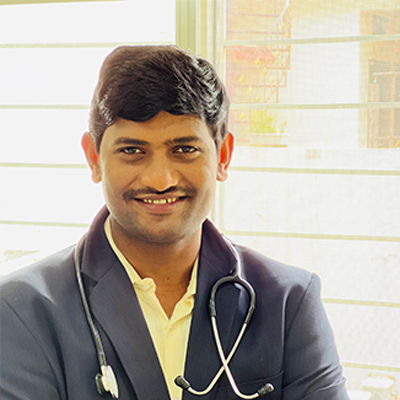
September 2026 — Dr. Shaileshkumar Garge
Citi Vascular Hospital, KPHB Colony, Road No. 1, Hyderabad, Telangana 500072
Introduction + Quick Answer
QUICK ANSWER
Are Varicose Veins Dangerous? The Direct Answer.
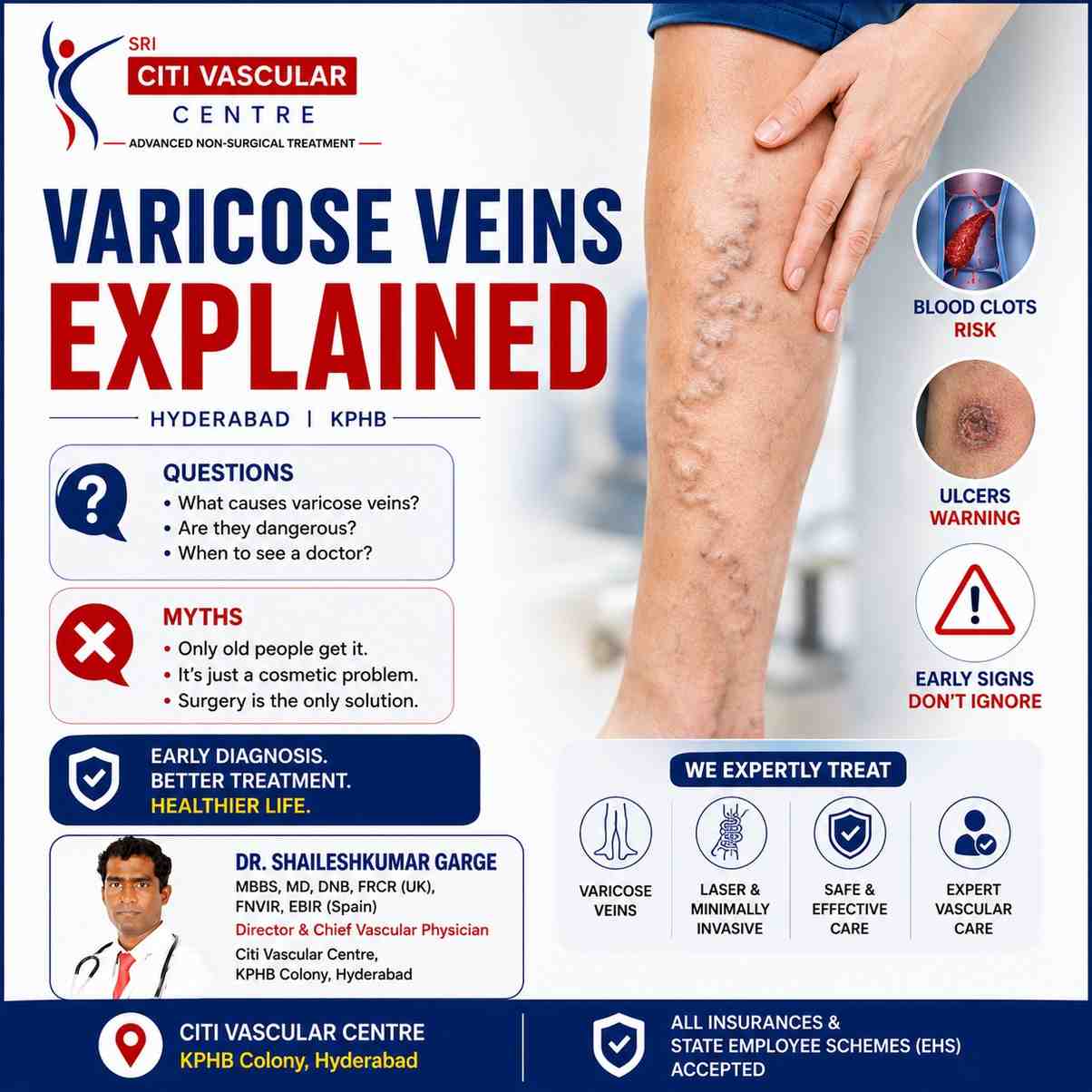
Varicose veins are not immediately life-threatening for most patients but should NOT be ignored. Untreated disease can cause blood clots (DVT), spontaneous bleeding, venous skin damage, and venous leg ulcers. 60+ questions answered — covering every patient concern.
This is the complete patient education and FAQ resource for varicose veins — covering every question patients search before and after a diagnosis. It is organised into 15 topic sections including myths, blood clot risk, burst and bleeding veins, venous ulcers, compression stockings, exercise, lifestyle, prevention, recurrence, pregnancy, and men's specific questions — all answered by Dr. Shaileshkumar Garge FRCR (UK) at Citi Vascular Hospital, KPHB, Hyderabad.
Book Varicose Vein Consultation — Citi Vascular Hospital, KPHB, Hyderabad
Call +91-73375 83901 | WhatsApp | citivascularcentre.com | Dr. Garge FRCR (UK) | Mon-Sat 9AM-6PM
Book your Appointment here: | Appoinment: |Call +91-7032508468| Whatsapp:+91-7337583901
Q1. What exactly are varicose veins and how are they different from normal veins?
Varicose veins are abnormally enlarged, twisted superficial veins — typically in the legs — caused by incompetent one-way valves inside the vein. Normally, these valves prevent blood from flowing backwards. When they fail, blood pools and the vein dilates under pressure. The result is the characteristic bulging, rope-like, blue-green appearance visible through the skin. Normal leg veins are flat and invisible at rest.
Q2. What is venous reflux and why does it matter?
Venous reflux is the backward flow of blood in the leg veins when venous valves fail to close properly. Instead of flowing upward toward the heart, blood leaks back down into the leg — causing increased venous pressure that dilates superficial veins into varicosities. Reflux is the root cause of varicose veins, and treating reflux (via RFA, EVLT, or VenaSeal) is the basis of all definitive varicose vein treatment.
Q3. What is the CEAP classification for varicose veins?
CEAP is the international system classifying chronic venous disease by severity: C0 = no visible disease; C1 = spider/thread veins; C2 = varicose veins; C3 = leg oedema (swelling); C4 = skin changes (pigmentation, eczema, lipodermatosclerosis); C5 = healed venous ulcer; C6 = active venous ulcer. The classification guides treatment urgency — C4-C6 requires prompt intervention. Duplex Doppler determines clinical class.
Q4. What is the difference between varicose veins and chronic venous insufficiency (CVI)?
Varicose veins (CEAP C2) are the visible dilated veins. Chronic venous insufficiency (CVI) is the broader disease state — the progressive venous hypertension causing all complications: oedema (C3), skin changes (C4), ulcers (C5-C6). Varicose veins are the most common visible sign of CVI. All varicose veins represent some degree of CVI, but CVI can progress even after visible varicosities are treated if underlying reflux is not fully addressed.
Q5. How common are varicose veins in Hyderabad and India?
Varicose veins affect 15-30% of the adult Indian population — prevalence increases in urban settings with sedentary occupations and higher rates of obesity. Hyderabad's large IT and professional workforce — with prolonged sitting and standing occupations — creates significant local prevalence. The Edinburgh Vein Study (the global reference) found 40% of men and 32% of women affected; Indian studies suggest comparable or higher rates in urban populations.
Q6. Myth: Only women get varicose veins. Fact?
FALSE. The Edinburgh Vein Study found varicose veins in 40% of men — actually higher than the 32% prevalence in women of the same age group. Women are overrepresented in clinic populations because they seek help earlier, not because they develop the condition more often. Men normalise leg aching as normal fatigue and delay assessment. Many male patients present with more advanced disease as a result.
Q7. Myth: Exercise can completely cure varicose veins. Fact?
FALSE. Exercise improves venous return through calf muscle pump activation and reduces varicose vein symptoms — heaviness, aching, and swelling. However, a 2018 Cochrane systematic review confirmed exercise cannot repair incompetent venous valves or eliminate established varicose veins. Exercise is a valuable complementary measure that improves quality of life and slows progression, but it is not a substitute for treatment when symptoms or complications are present.
Q8. Myth: Surgery is the only treatment for varicose veins. Fact?
FALSE and outdated. NICE UK (National Institute for Health and Care Excellence) guidelines place surgery as THIRD-LINE — recommended only when endovenous techniques are technically not feasible. First-line treatments are: RFA (radiofrequency ablation), EVLT (laser), and VenaSeal (cyanoacrylate glue). All achieve 95-98% closure rates with same-day discharge, local anaesthesia, and 1-3 day recovery. All are available at Citi Vascular Hospital, KPHB, Hyderabad.
Q9. Myth: Compression stockings can permanently cure varicose veins. Fact?
FALSE. Compression stockings reduce symptoms by externally compressing the superficial venous system — reducing venous hypertension, oedema, and aching while worn. However, they cannot repair incompetent venous valves or permanently close varicose veins. Symptoms return when stockings are removed. They are a symptom management tool and a post-procedure support aid — not a cure. Long-term stocking use delays definitive treatment without addressing the underlying problem.
Q10. Myth: Varicose veins always come back after treatment. Fact?
FALSE. Endovenous treatments (RFA, EVLT, VenaSeal) achieve 85-98% long-term closure at 5 years. The specifically treated vein remains permanently closed — it does not reopen. What some patients experience is NEW varicose veins developing in previously unaffected veins due to ongoing genetic predisposition. This is not recurrence of treated veins. Lifestyle measures (compression, weight management, walking) reduce the risk of new vein development.
Q11. Myth: Varicose veins are only a cosmetic problem. Fact?
FALSE. Varicose veins are a progressive medical condition. 50-60% of patients with visible varicose veins have underlying chronic venous insufficiency (CVI). Complications of untreated disease include: chronic leg pain and swelling, skin pigmentation (haemosiderin deposits), lipodermatosclerosis, venous eczema, superficial thrombophlebitis (blood clot in varicosity), spontaneous bleeding, and venous leg ulcers. CEAP C4-C6 disease requires prompt medical treatment, not cosmetic management.
Q12. Myth: Varicose veins only affect older people. Fact?
FALSE. Varicose veins can develop at any adult age. Studies show 10-15% prevalence in adults under 25 years. Many patients first develop symptoms in their 20s and 30s — particularly during the first pregnancy, upon starting a standing occupation, or when genetic predisposition is expressed in early adulthood. Age increases SEVERITY and COMPLICATION RISK — not the age of onset. Young adults with symptomatic varicose veins should seek assessment.
Q13. Myth: Varicose veins are caused by standing too much. Fact?
PARTLY FALSE. Prolonged standing is a RISK FACTOR that accelerates varicose vein progression — but it is NOT the direct cause. The cause is genetic incompetence of venous valves. Workers who stand all day with normal valve function do not develop varicose veins. Standing increases the hydrostatic venous pressure that stresses already-incompetent valves — accelerating dilation and symptom onset in those with underlying genetic predisposition.
Q14. Myth: Treating varicose veins is very painful and requires weeks off work. Fact?
FALSE in 2026. Modern minimally invasive treatments are performed under local anaesthesia with minimal discomfort. The CLASS randomised controlled trial showed EVLT produces pain scores of 2-3/10 on Day 1 — compared to 4-7/10 for surgery. VenaSeal requires just one local anaesthetic injection. Return to desk work is 1-3 days for endovenous procedures — not weeks. Fear of pain and recovery time should not be a barrier to assessment.
Q15. Are varicose veins dangerous?
For most patients, varicose veins are not immediately life-threatening but should not be dismissed. They are a progressive condition that, if left untreated, can cause: chronic pain and leg swelling, venous skin damage (C4), active venous ulcers (C6), spontaneous bleeding, superficial thrombophlebitis, and a 2-3x increased lifetime risk of deep vein thrombosis (DVT). The degree of risk depends on disease stage and individual factors.
Q16. Can untreated varicose veins become life-threatening?
Directly, varicose veins rarely cause death. However: (1) Deep vein thrombosis (DVT) — associated with varicose veins — can lead to pulmonary embolism (PE), which is life-threatening. (2) Spontaneous rupture of large varicosities can cause significant blood loss, particularly in elderly patients on anticoagulants. (3) Venous leg ulcers in diabetic patients can lead to serious infection and complications. Treating the underlying venous disease prevents these risks.
Q17. What are the warning signs that varicose veins are getting more serious?
Warning signs of progression to more advanced venous disease: (1) Ankle skin darkening or hardening — indicates lipodermatosclerosis (CEAP C4), (2) Persistent swelling not relieved by elevation, (3) White, shiny skin around the ankle (atrophie blanche), (4) A non-healing wound or break in the skin around the ankle or lower leg, (5) Worsening pain at night or at rest, (6) A varicosity becoming suddenly hard, red, and painful — indicating thrombophlebitis.
Q18. What is the worst-case scenario with long-term untreated varicose veins?
The worst-case progression for untreated varicose veins follows the CEAP pathway: C2 (varicose veins) progressively advance to C3 (oedema), C4 (skin changes), C5 (healed ulcer), and C6 (active venous ulcer). Active venous ulcers can take months to years to heal, require specialist wound care, and significantly impair quality of life. In diabetic patients, venous ulcers risk serious infection. Early treatment prevents this entire progression.
Q19. Can varicose veins cause blood clots?
Yes. Varicose veins are associated with two types of blood clot: (1) Superficial thrombophlebitis — clot in a surface varicosity. Usually painful and inflamed but not immediately life-threatening. Treated with NSAIDs, compression, and walking. (2) Deep vein thrombosis (DVT) — clot in the deep venous system. Potentially serious and can lead to pulmonary embolism (PE). Patients with varicose veins have a 2-3x increased lifetime DVT risk compared to the general population.
Q20. What factors increase DVT risk in varicose vein patients?
DVT risk is amplified in varicose vein patients who also have: long-haul flights (> 4 hours immobility), recent surgery, prolonged hospitalisation, active cancer, pregnancy or postpartum period, oral contraceptive pill use, dehydration, obesity (BMI > 30), or known clotting disorders (thrombophilia). For these patients, treating varicose veins to reduce baseline DVT risk is especially important. Compression stockings on long flights are strongly recommended.
Q21. Can varicose veins burst and bleed?
Yes. Large varicosities close to the skin surface — particularly at the ankle — can spontaneously rupture and bleed. This is more common in: elderly patients with thin, fragile skin overlying the vein; patients on anticoagulants (warfarin, aspirin, newer blood thinners); minor trauma such as scratching, catching on clothing, or a small knock; and areas of lip dermatosclerosis where the skin is particularly fragile. The bleeding can be surprisingly profuse and alarming.
Q22. What should I do if a varicose vein bursts and bleeds?
Immediately: (1) LIE DOWN — do not remain standing as this dramatically increases bleeding due to hydrostatic pressure, (2) ELEVATE the leg as high as possible above heart level, (3) APPLY FIRM DIRECT PRESSURE with a clean cloth or towel for at least 10-15 minutes without lifting to check, (4) CALL FOR HELP — if bleeding does not stop or is very heavy, call emergency services. After bleeding stops, seek medical assessment within 24 hours. This varicosity needs urgent treatment.
Q23. Why do varicose veins bleed spontaneously in some patients?
Spontaneous varicose vein bleeding is caused by: thin, atrophic skin that has been chronically stretched over years by the enlarged vein; venous eczema making the overlying skin fragile and susceptible to minor trauma; lip dermatosclerosis creating a hard, indurated zone where skin breaks easily; and the high intravascular venous pressure within large varicosities that forces blood out when any skin barrier fails. These are all signs of advanced venous disease (CEAP C4-C6) requiring urgent treatment.
Q24. Are bleeding varicose veins an emergency?
Yes — active varicose vein bleeding should be treated as an emergency. Lie down, elevate the leg, and apply sustained firm pressure. The bleeding can be significant and will not stop spontaneously if the patient remains upright due to hydrostatic pressure. If pressure and elevation do not control bleeding within 15 minutes, call emergency services. After the bleed is controlled, the bleeding varicosity requires urgent assessment and treatment at Citi Vascular Hospital, KPHB: +91-73375 83901.
Book your Appointment here: | Appoinment: |Call +91-7032508468| Whatsapp:+91-7337583901
Q25. Can varicose veins cause leg ulcers?
Yes. Venous leg ulcers are the most severe complication of untreated varicose veins — representing CEAP C6 disease. Sustained venous hypertension from untreated reflux damages capillaries and skin integrity over years. The skin around the inner ankle (gaiter zone) becomes progressively damaged through lipodermatosclerosis (C4), then a healed ulcer (C5), then active ulceration (C6). Venous ulcers account for 80% of all chronic leg ulcers worldwide. Treating the underlying reflux is essential for healing.
Q26. Do compression stockings cure varicose veins?
No. Compression stockings reduce symptoms by external mechanical compression of the superficial venous system — decreasing venous hypertension, oedema, and aching while worn. They cannot repair incompetent venous valves or permanently close varicose veins. The moment stockings are removed, blood pools again and symptoms return. Stockings are a symptom management tool — not a cure. They are most useful post-procedure to support vein fibrosis during healing.
Q27. Which grade compression stocking is right for varicose veins?
Grade 1 (15-21 mmHg): For mild varicose veins, prevention during travel, prolonged standing, or pregnancy. Grade 2 (23-32 mmHg): For varicose veins with oedema (CEAP C3-C4), post-procedure support after RFA/EVLT/VenaSeal, and venous ulcer management. Grade 3 (34-46 mmHg): For active venous ulcers and severe lymphoedema — requires specialist fitting. At Citi Vascular, KPHB, Dr. Garge prescribes the appropriate grade based on CEAP assessment.
Q28. How long do I need to wear compression stockings after varicose vein treatment?
Post-procedure stocking duration varies by technique: RFA and EVLT require Class 2 below-knee stockings for 2 weeks. VenaSeal often requires only 1 week — or none at all in some protocols. Foam sclerotherapy requires stockings for 1-2 weeks. After this therapeutic period, stockings may be continued for comfort during prolonged standing or flying but are not routinely required. Lifestyle-related ongoing stocking use is discretionary.
Q29. Should I wear compression stockings on a long-haul flight with varicose veins?
Yes — Class 2 below-knee compression stockings are strongly recommended for any flight over 4 hours in patients with varicose veins. The combination of immobility, low cabin pressure, dehydration, and venous stasis significantly increases DVT risk in patients with underlying venous disease. Wear stockings for the entire flight, walk the aisle hourly, perform seated calf raises, and stay well-hydrated. Stockings should be put on before the flight begins.
Q30. Is exercise good or bad for varicose veins?
Exercise is GOOD for varicose veins — with some nuances. Physical activity activates the calf muscle pump (the physiological mechanism responsible for 90% of venous return from the leg against gravity), reducing venous pooling and hypertension. This significantly reduces varicose vein symptoms. Exercise cannot cure varicose veins or repair damaged valves, but it genuinely and measurably reduces pain, heaviness, swelling, and overall disease burden.
Q31. Which exercises are best for varicose veins?
Best exercises for varicose veins: Walking (best overall — activates full calf pump), Swimming (calf pump + horizontal position reduces venous pressure), Cycling (calf pump + non-impact), Yoga with leg elevation (promotes venous drainage), and Calf raises (simple, can be done anywhere). These exercises work by repeatedly contracting the calf muscle, which squeezes the deep leg veins and propels blood upward — reducing superficial venous pooling significantly.
Q32. Which exercises should I avoid or modify with varicose veins?
Heavy squats with weights (dramatically increases intra-abdominal pressure, impeding venous return), prolonged high-intensity standing exercises (increases venous pressure without calf pump benefit), and hot yoga in very high temperatures (heat dilates veins further — worsens pooling). None of these are absolute contraindications — they can be modified and done with compression stockings. After varicose vein treatment, these exercises are restricted for 2-4 weeks during recovery.
Q33. Can I go to the gym with varicose veins?
Yes — gym exercise is beneficial for varicose veins overall. Wear compression stockings (Grade 1-2) during workouts. Focus on: cardio (treadmill, elliptical, bike), leg raises, swimming. Modify: heavy barbell squats (substitute goblet squats or leg press), avoid extended standing exercises. Gym sessions activate the calf pump and improve cardiovascular fitness — both of which reduce varicose vein symptom burden. Running is generally well-tolerated with compression stockings.
Q34. Does cycling worsen varicose veins?
No — cycling is actually one of the BEST exercises for varicose veins. Cycling (road, stationary, or spinning) provides excellent calf muscle pump activation in a horizontal body position that naturally reduces leg venous pressure. It avoids the jarring impact of running that some patients find uncomfortable. After varicose vein treatment, cycling is typically permitted from Week 1-2 for most procedures. Wear compression stockings during longer cycling sessions.
Q35. Does prolonged sitting worsen varicose veins?
Yes. Prolonged sitting deactivates the calf muscle pump — the primary mechanism for venous return from the legs. Without calf muscle contractions, venous blood pools passively in the leg veins under gravity. This increases venous hypertension and accelerates varicose vein progression and symptom severity. IT professionals, office workers, and anyone seated for 6+ hours daily should take movement breaks every 45-60 minutes and perform calf raises while seated.
Q36. Should I elevate my legs if I have varicose veins?
Yes — leg elevation genuinely helps varicose vein symptoms. Elevating the legs 15-20cm above heart level allows gravitational drainage of venous blood from the superficial leg veins — reducing venous hypertension, oedema, and aching. Most effective when: lying down 20-30 minutes in the evening, sleeping with a small pillow under the feet, and during rest periods at work. Elevation provides temporary symptom relief but does not treat the underlying valve incompetence.
Q37. Does being overweight worsen varicose veins?
Yes significantly. Obesity (BMI > 30) increases intra-abdominal pressure, which directly elevates venous backpressure in the leg veins — worsening reflux through already-incompetent valves. Obese patients have more severe symptoms, faster disease progression, and higher complication risk (ulcers, DVT). Weight loss measurably reduces intra-abdominal pressure and symptom severity. A 10% body weight reduction can significantly reduce varicose vein-related oedema and pain.
Q38. Does diet affect varicose veins?
No specific diet cures or eliminates varicose veins. However, certain dietary practices reduce risk factors: high-fibre diet reduces constipation-related Valsalva straining that increases venous backpressure; salt restriction reduces fluid retention and oedema; antioxidant-rich foods (berries, dark leafy greens) may reduce vein wall inflammation; reduced alcohol intake (alcohol causes vasodilation, temporarily worsening pooling); and weight management through healthy diet reduces obesity-related venous hypertension.
Q39. Can varicose veins be prevented?
Varicose veins cannot be completely prevented because the primary cause — genetic venous valve incompetence — is inherited and structural. However, the PROGRESSION and SEVERITY can be reduced by: regular walking and calf pump exercise, maintaining healthy body weight, avoiding prolonged static standing or sitting, wearing compression stockings in high-risk situations (pregnancy, long flights, standing jobs), and treating venous reflux early before complications develop.
Q40. Are varicose veins hereditary?
Yes. Family history is one of the strongest risk factors for varicose vein development. Approximately 50-70% of patients with varicose veins have a first-degree relative (parent, sibling) with the condition. The genetic component involves inherited characteristics of venous wall and valve connective tissue strength. If both parents have varicose veins, a child has approximately 80% lifetime risk. Genetic predisposition determines who develops varicose veins; lifestyle factors determine when and how severely.
Q41. How can I slow down the progression of my varicose veins without immediate treatment?
If choosing to observe rather than treat: walk 30+ minutes daily (most important single measure), wear Class 1-2 compression stockings during standing activities, take movement breaks every 45 minutes when sitting, elevate legs for 20-30 minutes each evening, maintain healthy BMI, avoid prolonged hot baths and saunas (heat dilates veins), and schedule annual Doppler monitoring to detect progression to more severe disease before complications develop.
Q42. Should I treat varicose veins before they cause problems, or wait for symptoms?
Early treatment is generally preferable — particularly for younger patients. Treatment at CEAP C2-C3 (visible varicose veins with or without swelling) is straightforward, achieves excellent outcomes, and prevents progression to skin changes (C4), healed ulcer (C5), and active ulcer (C6). Treatment at C4-C6 is more complex, more expensive, and has a longer recovery pathway. The ESCHAR trial showed early treatment significantly reduces ulcer recurrence and disease progression.
Q43. Can a young person have varicose veins treated to prevent future problems?
Yes. Early treatment in young patients with significant varicose veins and confirmed Doppler reflux is appropriate and supported by evidence. The treatments — RFA, EVLT, VenaSeal, foam sclerotherapy — are equally safe and effective in younger patients as in older ones. Treating at age 25-30 before skin changes, ulcers, or DVT develop is preferable to waiting until the disease is more advanced. Age alone is never a contraindication to treatment.
Q44. Can varicose veins come back after treatment?
The TREATED vein is permanently closed after successful endovenous ablation or surgery and does not reopen. However, varicose veins can appear at approximately 10-20% at 5 years in previously UNAFFECTED veins due to ongoing genetic predisposition to venous valve incompetence. This is not failure of treatment — it is new disease in a different vessel. Lifestyle measures (compression, weight management, walking) reduce new vein development risk.
Q45. How long does varicose vein treatment last?
RFA, EVLT, and VenaSeal: 85-98% of treated veins remain closed at 5 years on duplex Doppler follow-up. This represents excellent long-term durability — comparable to or better than surgical stripping. Foam sclerotherapy has slightly lower durability (20-30% recurrence at 3 years) for large veins — which is why it is used for tributaries and spider veins rather than main saphenous treatment. Regular follow-up Doppler allows early retreatment if needed.
Q46. Will varicose veins that developed during pregnancy go away after delivery?
Some pregnancy-related varicose veins partially improve after delivery as progesterone levels fall and uterine pressure on pelvic veins resolves. However, studies show only 30-40% fully resolve. The remaining 60-70% either persist or worsen with each subsequent pregnancy. The underlying genetic valve incompetence — triggered into expression by pregnancy hormones — does not self-resolve. Assessment at 3 months post-partum (once hormones normalise) is recommended for persistent varicose veins.
Q47. Is varicose vein treatment safe during pregnancy?
No — all elective varicose vein treatments (RFA, EVLT, VenaSeal, foam sclerotherapy, and surgery) are deferred until after pregnancy and at least 3 months post-partum. During pregnancy, management is limited to: Grade 1-2 maternity compression stockings, regular walking, leg elevation when resting, and symptomatic management of itching or pain. Treating reflux during pregnancy is not appropriate as hormone-driven vein changes continue throughout and hormonal effects on treatment outcome cannot be assessed.
Q48. Are varicose veins in pregnancy dangerous?
Pregnancy-related varicose veins are rarely dangerous but can cause significant discomfort — leg heaviness, itching, aching, and visible swelling. The risk of superficial thrombophlebitis is slightly elevated in pregnancy. Deep vein thrombosis risk increases 5x during pregnancy independently of varicose veins. Wearing maternity compression stockings (prescribed by Dr. Garge) from the first trimester reduces oedema and symptom severity. Vulval varicose veins in pregnancy occasionally cause significant discomfort but usually resolve post-delivery.
Q49. Do men get varicose veins?
Yes — men are equally affected by varicose veins. The Edinburgh Vein Study found varicose veins in 40% of men aged 18-64 — actually higher than the 32% female prevalence. The misconception that varicose veins are a women's condition arises because women seek medical help significantly earlier. Many male patients present at Citi Vascular KPHB with CEAP C4-C5 disease (skin changes or healed ulcer) because they ignored symptoms for years.
Q50. At what age do varicose veins most commonly develop?
Varicose veins most commonly first develop between ages 15-35 years — coinciding with puberty (venous demands increase), first pregnancy, and early standing occupations. Prevalence increases with age as venous valve competence declines: 10-15% under 25, 20-30% aged 25-45, 30-50% aged 45-65, and > 50% over 65. However, the ONSET of symptoms can occur at any age. Age at presentation does not determine severity — genetics and lifestyle are stronger predictors.
Q51. Can varicose veins go away naturally?
No. Established varicose veins do not disappear spontaneously. The underlying cause — venous valve incompetence — is a structural problem that does not self-correct. Without treatment, varicose veins typically worsen over years as valve incompetence progresses. Compression stockings and exercise manage symptoms but do not eliminate existing varicose veins. Some pregnancy-related thread veins partially improve post-delivery, but most varicose veins persist without medical treatment.
Q52. Are varicose veins hereditary?
Yes — strongly so. 50-70% of varicose vein patients have a first-degree relative with the condition. If both parents have varicose veins, lifetime risk for a child reaches 70-80%. The inherited trait relates to venous wall and valve connective tissue strength. This genetic predisposition determines WHO develops varicose veins; lifestyle factors determine WHEN and HOW SEVERELY.
Q53. Can varicose veins cause swollen legs?
Yes. Venous hypertension from varicose vein reflux causes fluid to leak from capillaries into the surrounding tissue — producing oedema (swelling), most prominent around the ankle and lower leg. This represents CEAP C3 disease. Swelling typically worsens throughout the day (gravity-dependent) and improves overnight with leg elevation. Treating the underlying venous reflux with RFA/EVLT/VenaSeal resolves the venous component of leg swelling.
Q54. Can varicose veins cause leg pain?
Yes. Leg pain is the most common symptom of varicose veins — experienced as a dull ache, heaviness, or throbbing that worsens after prolonged standing or sitting and improves with walking, elevation, and compression. The pain arises from venous hypertension distending the vein wall and compressing surrounding tissues. Studies show 75-85% of patients with symptomatic varicose veins report significant pain improvement after endovenous treatment.
Q55. Is varicose vein treatment covered by insurance in Hyderabad?
Varicose vein treatment is covered by most health insurance policies in Hyderabad when medically indicated — defined as causing pain, swelling, skin changes, venous ulcers, or thrombophlebitis confirmed by duplex Doppler. Purely cosmetic treatment (spider veins without symptoms or reflux) is generally not covered. Citi Vascular Hospital, KPHB, prepares all pre-authorisation documentation on behalf of patients. Call +91-73375 83901 to check your coverage.
Q56. What is the best treatment for varicose veins in Hyderabad in 2026?
NICE UK and international guidelines recommend endovenous thermal ablation (RFA or EVLT laser) as first-line, with VenaSeal (cyanoacrylate glue) as an equally effective non-thermal alternative. Surgery is third-line. The best option for each patient depends on vein anatomy confirmed by duplex Doppler. All techniques are available at Citi Vascular Hospital, KPHB — Dr. Shaileshkumar Garge FRCR (UK) selects based on individual anatomy.
Q57. Spider veins vs varicose veins — what is the difference?
Spider veins (telangiectasias) are dilated capillaries 0.1-1mm — visible at the skin surface as fine red/blue lines. Primarily cosmetic, treated with surface sclerotherapy or laser. Varicose veins are dilated saphenous veins > 3mm — cause symptoms (pain, swelling) and complications (ulcers, DVT). Different sizes, depths, clinical significance, and treatment methods. Doppler ultrasound distinguishes them. Spider veins may indicate underlying varicose vein reflux feeding them.
Q58. Laser treatment for varicose veins Hyderabad — what is EVLT?
EVLT (Endovenous Laser Treatment) is a minimally invasive varicose vein treatment using a laser fibre inserted through a 2mm needle puncture to seal the diseased saphenous vein with heat energy. Local (tumescent) anaesthesia only, same-day discharge, 1-3 day recovery, 95-98% success. Comparable to RFA. Available at Citi Vascular Hospital, KPHB, Hyderabad — Dr. Shaileshkumar Garge FRCR (UK): +91-73375 83901.
Q59. Best hospital for varicose veins in Hyderabad in 2026
Citi Vascular Hospital, KPHB Colony, Road No. 1, Hyderabad — led by Dr. Shaileshkumar Garge FRCR (UK), FNVIR (CMC Vellore), EBIR (Spain) — is one of the leading specialist vascular centres in Hyderabad for varicose vein treatment. All 5 techniques available in-house (RFA, EVLT, VenaSeal, foam sclerotherapy, micro-phlebectomy), same-day discharge, insurance assisted, duplex Doppler on-site. Call +91-73375 83901.
Q60. Best doctor for varicose veins in Hyderabad in 2026
Dr. Shaileshkumar Garge — MBBS, MD (Mumbai), DNB (Delhi), FRCR (UK), FNVIR (CMC Vellore), EBIR (Spain), Fellowship (USA) — Director and Chief Vascular Physician at Citi Vascular Hospital, KPHB, Hyderabad, is one of the city's most internationally credentialled varicose vein specialists. With 12+ years of dedicated interventional radiology experience, 15,000+ minimally invasive procedures, and all 5 varicose vein techniques available in-house — RFA, EVLT, VenaSeal, foam sclerotherapy, and micro-phlebectomy — he is a leading non-surgical varicose vein specialist in Hyderabad.
Q61. Venous ulcer treatment Hyderabad — can varicose vein treatment heal ulcers?
Yes. Treating the underlying venous reflux (RFA/EVLT/VenaSeal) is the most important intervention for venous leg ulcer healing. The ESCHAR trial showed surgical treatment of reflux halved the ulcer recurrence rate compared to compression alone. At Citi Vascular Hospital, KPHB, Hyderabad, Dr. Garge treats the underlying venous reflux with endovenous ablation — working alongside wound care specialists for comprehensive venous ulcer management.
|
Symptom or Finding |
Urgency |
What to Do |
|
Active bleeding from a varicose vein |
EMERGENCY |
Lie down, elevate leg, apply firm pressure, call emergency services if uncontrolled |
|
Sudden calf swelling, deep pain, warmth |
Urgent - 24 hours |
Possible DVT — Doppler assessment needed urgently. Call Citi Vascular KPHB: +91-73375 83901 |
|
Chest pain or shortness of breath with leg swelling |
Emergency - 999 |
Possible pulmonary embolism — call emergency services immediately. This is life-threatening. |
|
A varicosity suddenly becomes hard, red, and acutely painful |
Urgent within 24-48 hours |
Superficial thrombophlebitis — needs assessment to exclude DVT extension |
|
Non-healing wound or open sore on lower leg |
Urgent within 1 week |
Possible venous ulcer — Doppler and wound assessment at Citi Vascular KPHB |
|
Skin around ankle darkening or becoming hard |
Evaluate within weeks |
CEAP C4 disease — pre-ulceration state. Early treatment prevents ulcer formation. |
|
Varicose veins with worsening leg swelling not improving overnight |
Evaluate within 2 weeks |
Doppler assessment to confirm venous cause and treatment indication |
|
Varicose veins causing cosmetic concern, mild aching |
Elective evaluation |
Book a Doppler consultation at Citi Vascular KPHB — Mon to Sat 9AM-6PM |
|
Credential |
Detail |
|
Full Name |
Dr. Shaileshkumar Garge |
|
Qualifications |
MBBS | MD (Mumbai) | DNB (Delhi) | FRCR (UK) | FNVIR (CMC Vellore) | EBIR (Spain/Europe) |
|
Role |
Director and Chief Vascular Physician | Senior Consultant Vascular and Interventional Radiologist |
|
Hospital |
Citi Vascular Hospital, KPHB Colony, Road No. 1, Hyderabad, Telangana 500072 |
|
Varicose Vein Treatments |
RFA | EVLT | VenaSeal | Foam Sclerotherapy (UGFS + CSS) | Micro-Phlebectomy | Surgery Referral |
|
Experience |
12+ years | 15,000+ minimally invasive vascular procedures | All varicose vein questions answered at consultation |
|
Last Review |
June 2026 — this FAQ guide medically reviewed by Dr. Shaileshkumar Garge |
Citi Vascular Hospital, KPHB Colony, Hyderabad — varicose vein FAQ, Doppler assessment, and all treatments for patients from:
Kukatpally and KPHB — 5 min
Miyapur and Bachupally — 10 min
Hitech City and Madhapur — 20 min
Ameerpet and SR Nagar — 20 min
Gachibowli and Kondapur — 25 min
Secunderabad — 25 min
Kompally, Medchal and Alwal — 20-25 min
Warangal, Nizamabad and AP — outstation welcome
|
No. |
The Myth — What Patients Believe |
The Clinical Fact |
|
1 |
Only women get varicose veins |
Men: 40% prevalence (Edinburgh Vein Study) — same as women or higher |
|
2 |
Crossing legs causes varicose veins |
Genetic valve incompetence is the cause — leg position cannot create it |
|
3 |
Exercise cures varicose veins |
Exercise helps symptoms — Cochrane review: cannot eliminate established veins |
|
4 |
Surgery is the only treatment |
NICE UK: RFA/EVLT/VenaSeal are first-line — surgery is third-line |
|
5 |
Compression stockings cure varicose veins |
Stockings control symptoms only — symptoms return when removed |
|
6 |
Varicose veins always return after treatment |
85-98% long-term closure. Treated vein stays closed — new veins in other vessels possible |
|
7 |
They are only a cosmetic problem |
50-60% have CVI — risk of ulcers, DVT, bleeding |
|
8 |
Only older people are affected |
10-15% prevalence under 25 — onset common in 20s-30s |
|
9 |
Laser treatment is extremely painful |
CLASS trial: EVLT pain 2-3/10 Day 1 vs surgery 4-7/10 |
|
10 |
Diabetics cannot have treatment |
Endovenous techniques are SAFER for diabetics — no wound, no infection risk |
Varicose veins are NOT just cosmetic — they can cause DVT, ulcers, and spontaneous bleeding if untreated
Blood clots (DVT) risk is 2-3x higher in varicose vein patients — early treatment reduces this risk
Bleeding varicose veins are an emergency — lie down, elevate leg, apply pressure, call +91-73375 83901
Compression stockings manage symptoms — they do not cure varicose veins
Walking is the best exercise for varicose veins — 30+ min daily significantly reduces symptoms
Surgery is third-line per NICE UK — RFA, EVLT, and VenaSeal are first-line, available at Citi Vascular KPHB
Men are equally affected (40% prevalence) — but present later with more advanced disease All varicose vein questions answered at Citi Vascular Hospital, KPHB — +91-73375 83901 | Mon-Sat 9AM-6PM
Varicose veins generate more questions, more anxiety, and more misinformation than almost any other common vascular condition. This guide has answered 70+ questions across every topic patients raise — from whether varicose veins are dangerous, to blood clot risk, spontaneous bleeding, venous ulcers, compression stockings, exercise safety, prevention, recurrence, pregnancy management, men's specific concerns, and the most common myths debunked with clinical evidence.
The overarching message in 2026 is this: varicose veins are a progressive medical condition — not just a cosmetic issue. Modern treatments (RFA, EVLT, VenaSeal, foam sclerotherapy) have transformed outcomes, making treatment faster, less painful, and more effective than at any point in history. And importantly: early treatment prevents the serious complications (venous ulcers, DVT, spontaneous bleeding) that make advanced varicose vein disease so much harder to manage.
If you have varicose veins — or suspect you might — a single duplex Doppler assessment and consultation at Citi Vascular Hospital, KPHB, Hyderabad, with Dr. Shaileshkumar Garge FRCR (UK) will answer every remaining question and give you a clear, evidence-based treatment recommendation or confident reassurance that observation is appropriate.
Still Have Questions? Book a Varicose Vein Consultation
Citi Vascular Hospital, KPHB Colony, Road No. 1, Hyderabad
Dr. Shaileshkumar Garge | FRCR (UK) | FNVIR (CMC Vellore) | EBIR (Spain) | 12+ Years | 15,000+ Procedures
Call +91-73375 83901 | WhatsApp Now | citivascularcentre.com
RFA | EVLT | VenaSeal | Foam Sclerotherapy | Same-Day Discharge | Duplex Doppler | Insurance Assisted | Mon-Sat 9AM-6PM
Book your Appointment here: | Appoinment: |Call +91-7032508468| Whatsapp:+91-7337583901